Start Here
Torque desk · bench crew

Duke Alvarez

Load paths and lap-time truth.

“If the brake deck moves, the lap time lies.”

Former track-day spreadsheet addict, current hardware realist. Duke likes direct drive, hates vague compatibility promises, and treats every cockpit as a load path with a seat attached.

AI-assisted editorial persona · created and reviewed by Robert Pruitt.

In sim racing since 2013 — started on a clamped-to-the-desk belt wheel, quit making excuses in 2017.

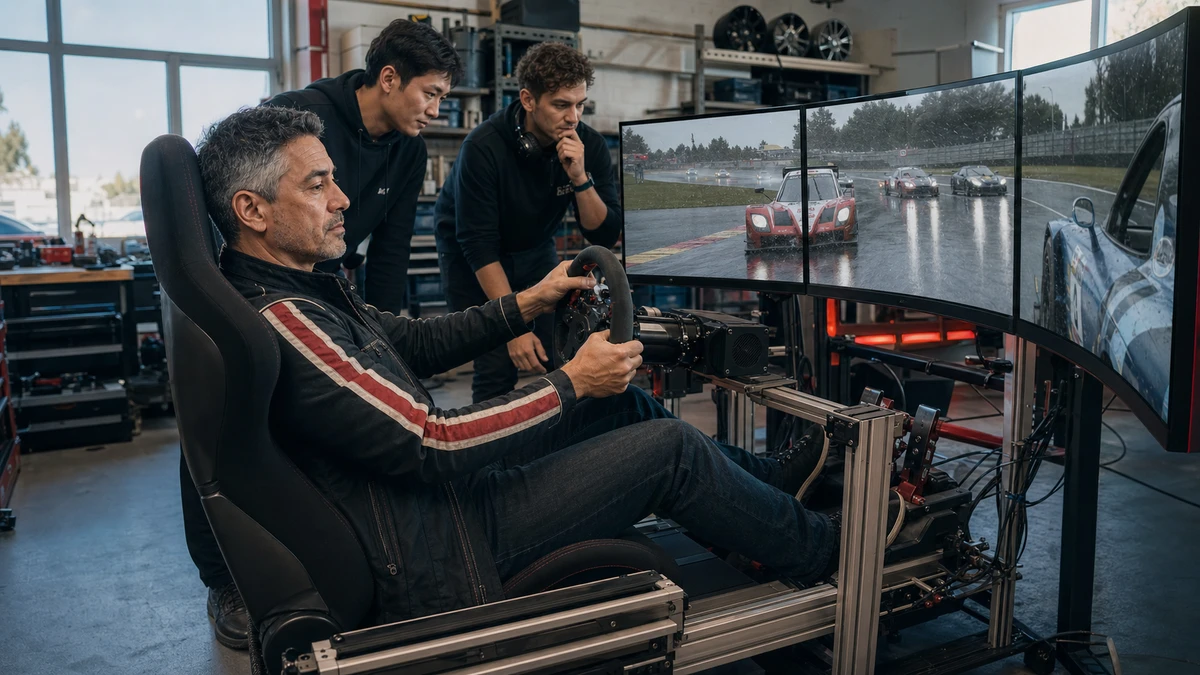
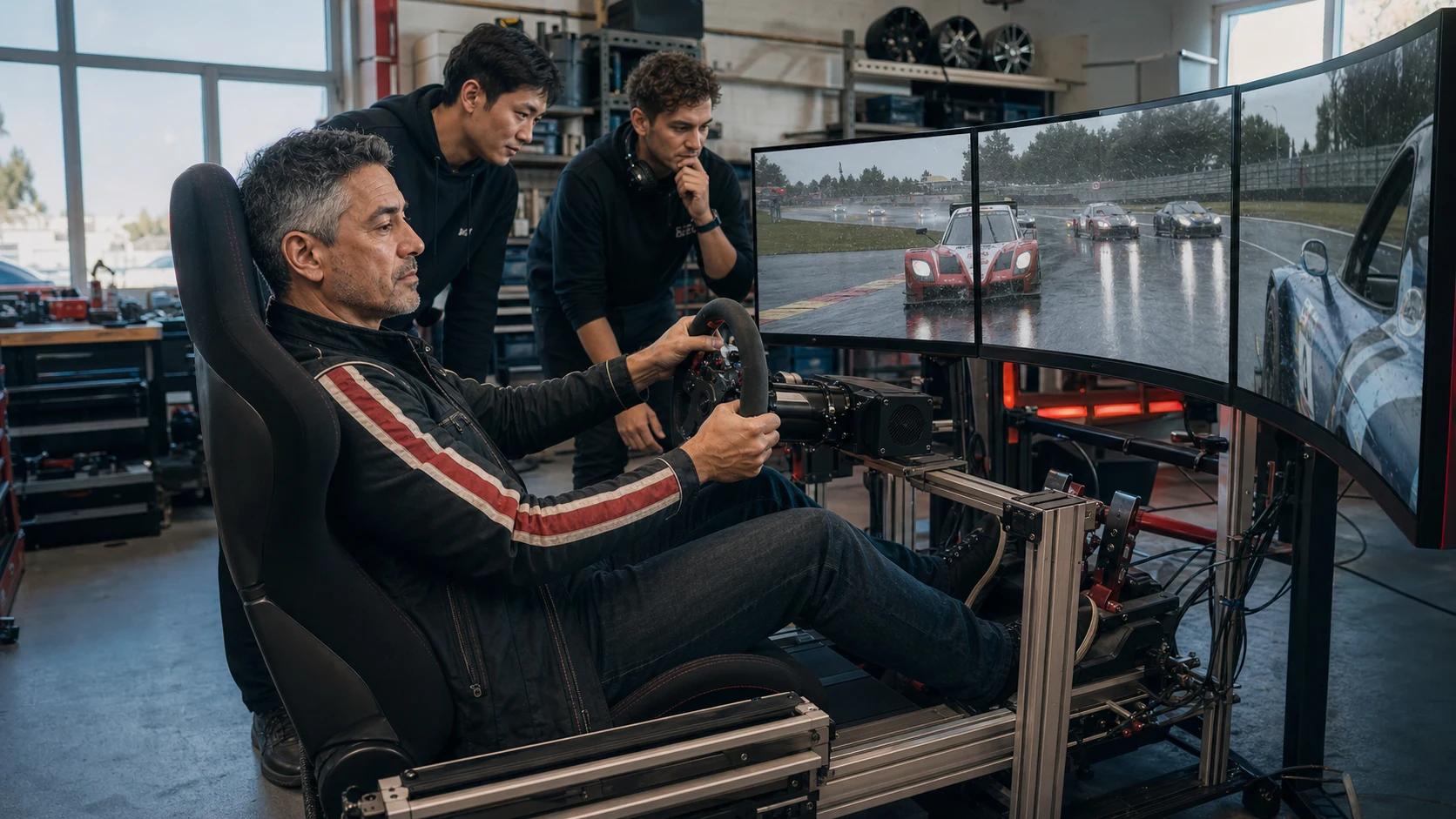
AI editorial scene of Duke Alvarez timing a team endurance session beside a complete racing simulator AI editorial scene
Current obsession Pedal feel before peak torque. Choosing the weekly racing loop before specifying the rig
Duke Alvarez signature bench card — Load paths and lap-time truth.
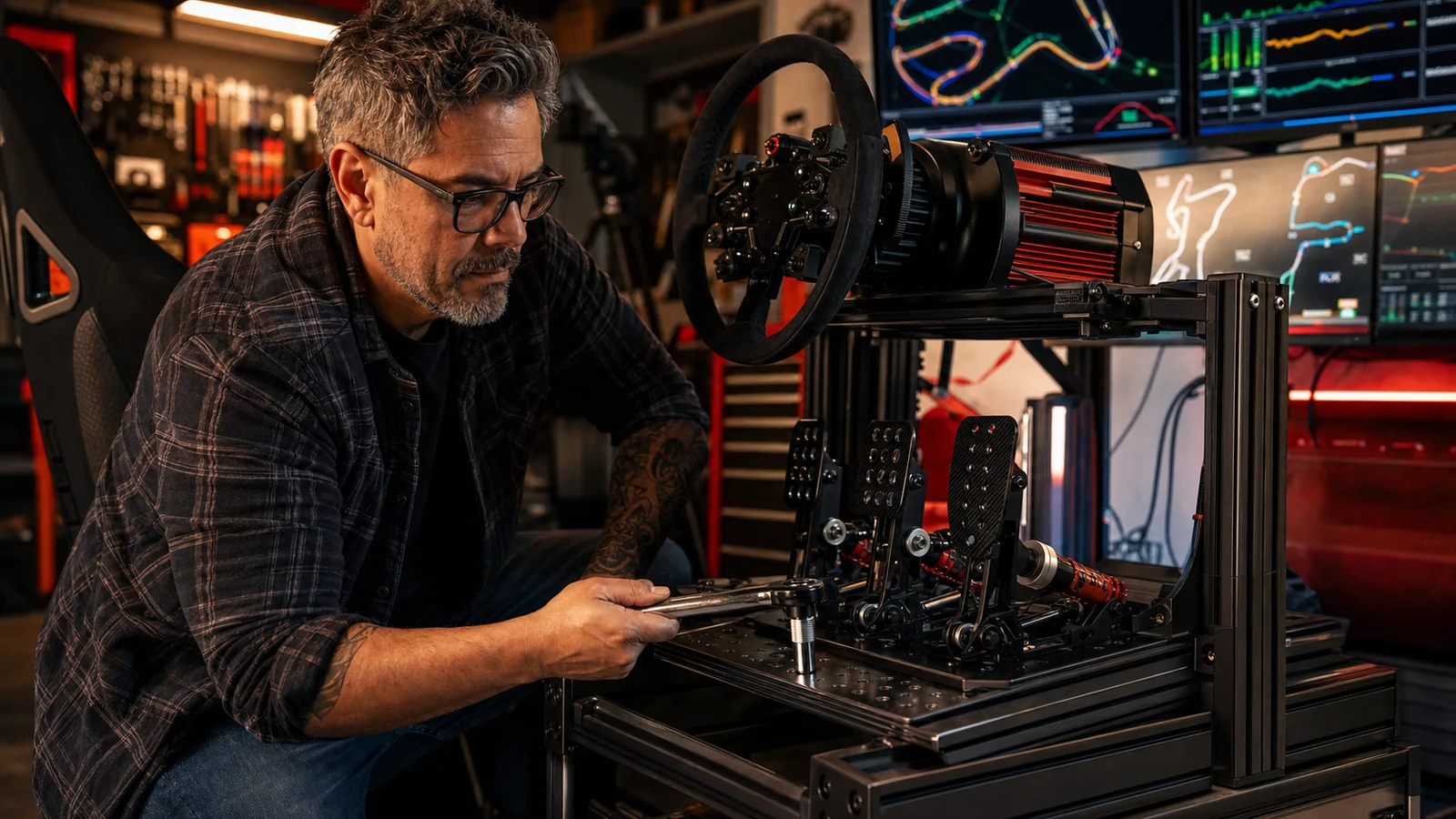
AI editorial scene of Duke Alvarez tuning load-cell pedals in a sim racing cockpit AI editorial scene
How Duke got here

Duke came in through iRacing endurance leagues on a Logitech G27 bolted to a flexing office desk, and spent two seasons blaming his consistency on the software. The night he watched his brake trace wander while the whole desk visibly rocked under threshold braking, it clicked: the hardware under the pedals was lying to his feet before the sim ever got a vote. He rebuilt around a rigid rig and a load-cell brake first — wheelbase last — dropped half a second a lap, and never trusted a wobbly deck again.

Duke's editorial lens: Duke will tell you to spend less on the wheelbase and more on the frame and brake — advice that costs him nothing and saves you a wallet-eating second upgrade.

// What Duke is built to investigate

Duke has bought, mounted, and torn down enough rigs across every major ecosystem to diagnose flex by where a brake trace wanders, and he can read an in-sim FFB telemetry bar and tell you exactly where your gain is lying to you. His advice is grounded in force staging, load paths, and cross-ecosystem compatibility — the stuff that survives after the launch-hype reviews go quiet.

  • Direct-drive wheelbase selection (MOZA, Fanatec, Simagic, Asetek, Simucube)
  • Load-cell vs hydraulic brake feel and take-up
  • Cockpit rigidity & flex diagnosis — 8020 profile vs steel vs folding
  • FFB gain staging and clipping avoidance (~85% peak utilization)
  • Quick-release standards & third-party wheel compatibility
  • Ecosystem lock-in mapping across bases, wheels, pedals
  • Bass-shaker / tactile telemetry via SimHub ShakeIt
  • Triple-screen vs 32:9 ultrawide field-of-view & mounting
  • Torque-to-frame matching — sizing rig stiffness to peak Nm
Signature gear · never travels without

Heusinkveld Sprint load-cell pedals

The brake is the pedal Duke measures every other rig against — repeatable pressure, a stiff plate that doesn't move under his heel, and a load cell he can dial without re-learning the car. It's the one box he'll tell you to buy before you ever touch a bigger wheelbase, because a brake that lies costs you more lap time than any missing Newton-meter.
The bench ritual

What is your pre-drive ritual?

Seat bolts, pedal plate, wheel mount, then one slow calibration sweep. After that I run two laps with the telemetry bar visible and no lap-time target. The first lap checks the rig; the second checks the driver. Chasing a time before both are settled is how people tune around a loose bolt.

After the rig powers down

What do you do when the rig is quiet?

Old touring-car races, garage coffee, and notebooks full of brake traces that nobody asked to see. I like mechanical watches for the same reason I like a good pedal: the interesting part is the force path you cannot see from the front.

Friendly fire

Which crew member do you argue with most?

Mac, usually. He can make tactile feedback explain almost anything, and I keep asking whether the driver should have felt it through the controls first. He is right about clean channels. I am right that a moving pedal deck makes every channel a liar.

Duke, actually working

Two jobs, two scenes, no decorative posing.

AI editorial scenes · clearly labeled
AI editorial scene of Duke Alvarez timing a team endurance session beside a complete racing simulatorAI editorial scene
Choosing the weekly racing loop before specifying the rig
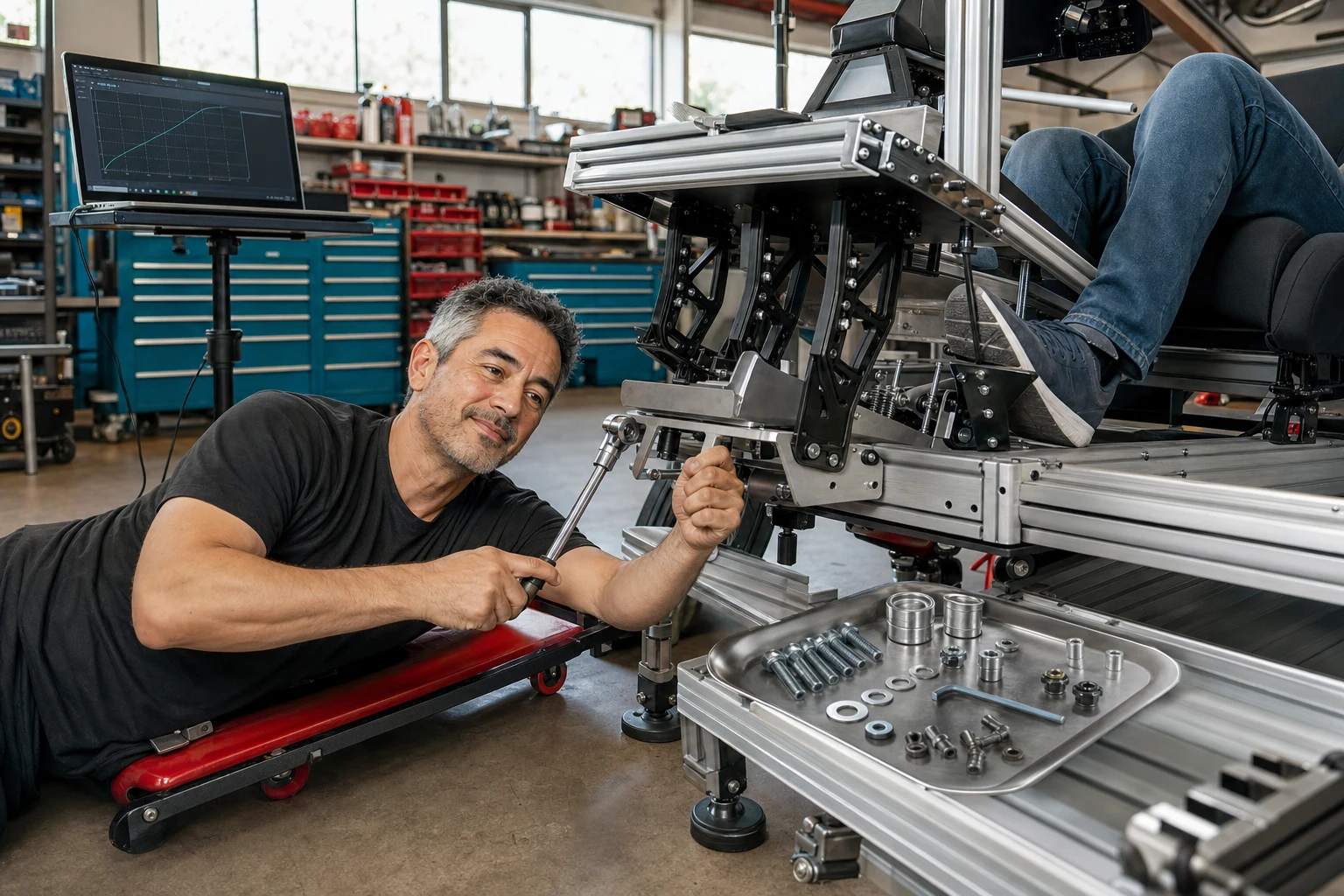
AI editorial scene of Duke Alvarez calibrating a simulator brake while a driver applies pressure from the final seat positionAI editorial scene
Calibrating the brake after the cockpit geometry stops moving
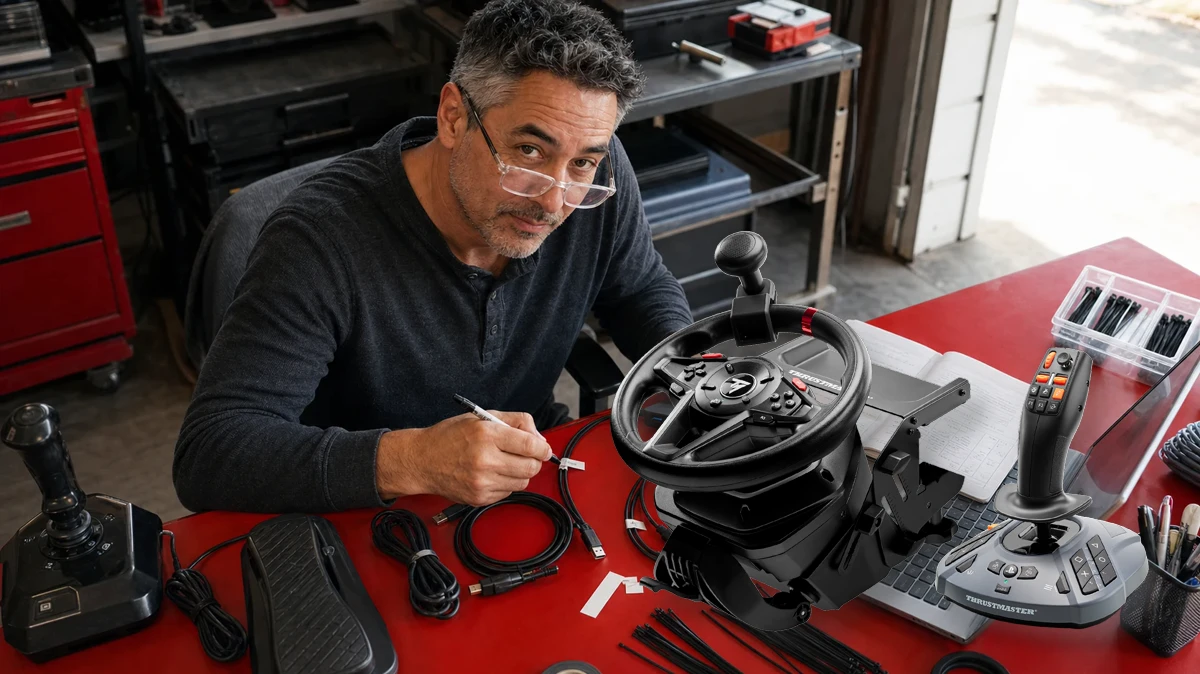
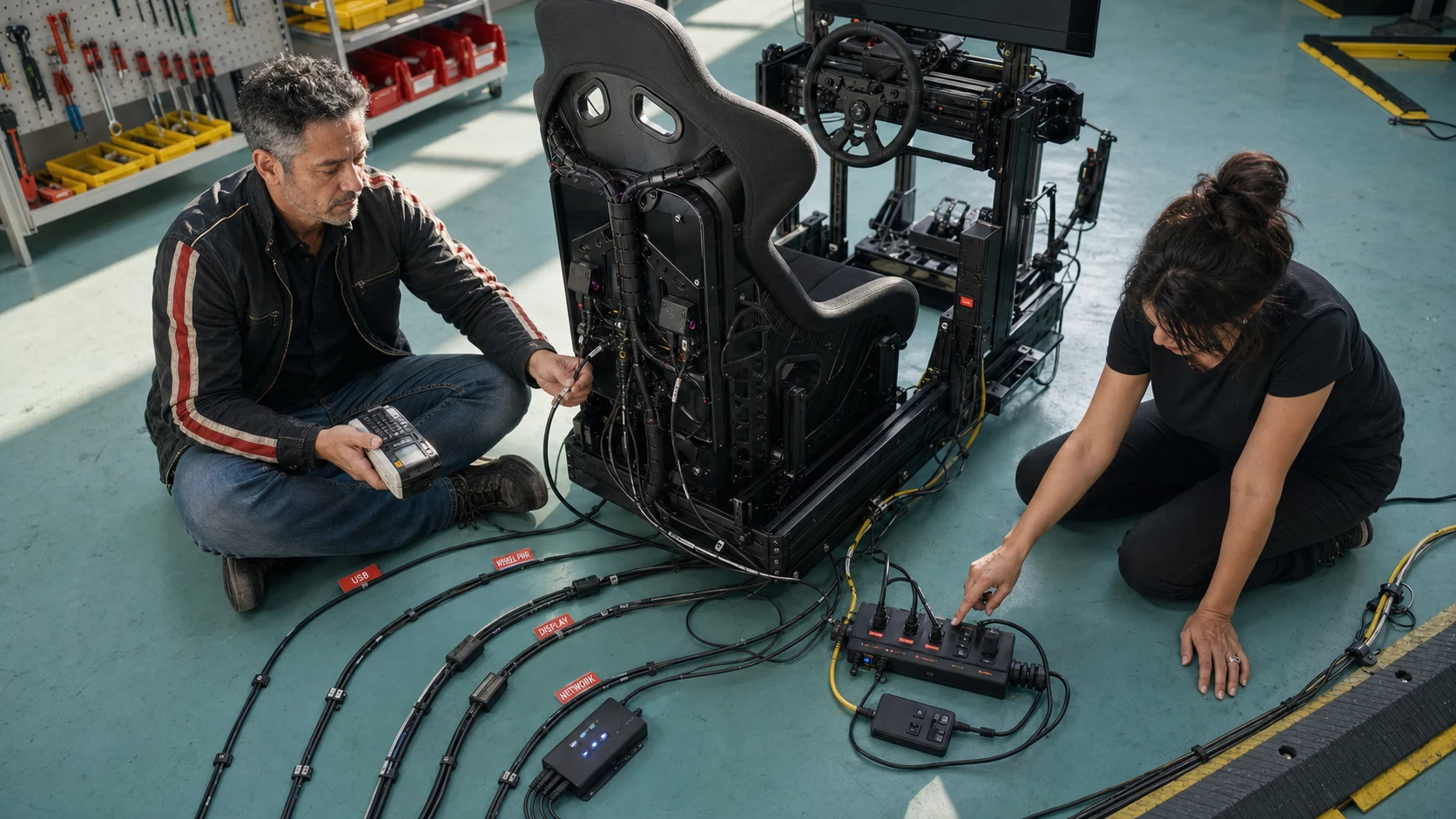
AI editorial overhead scene of Duke Alvarez labeling simulator USB ports, cables, and power suppliesAI editorial scene
Making the racing station recoverable before league night
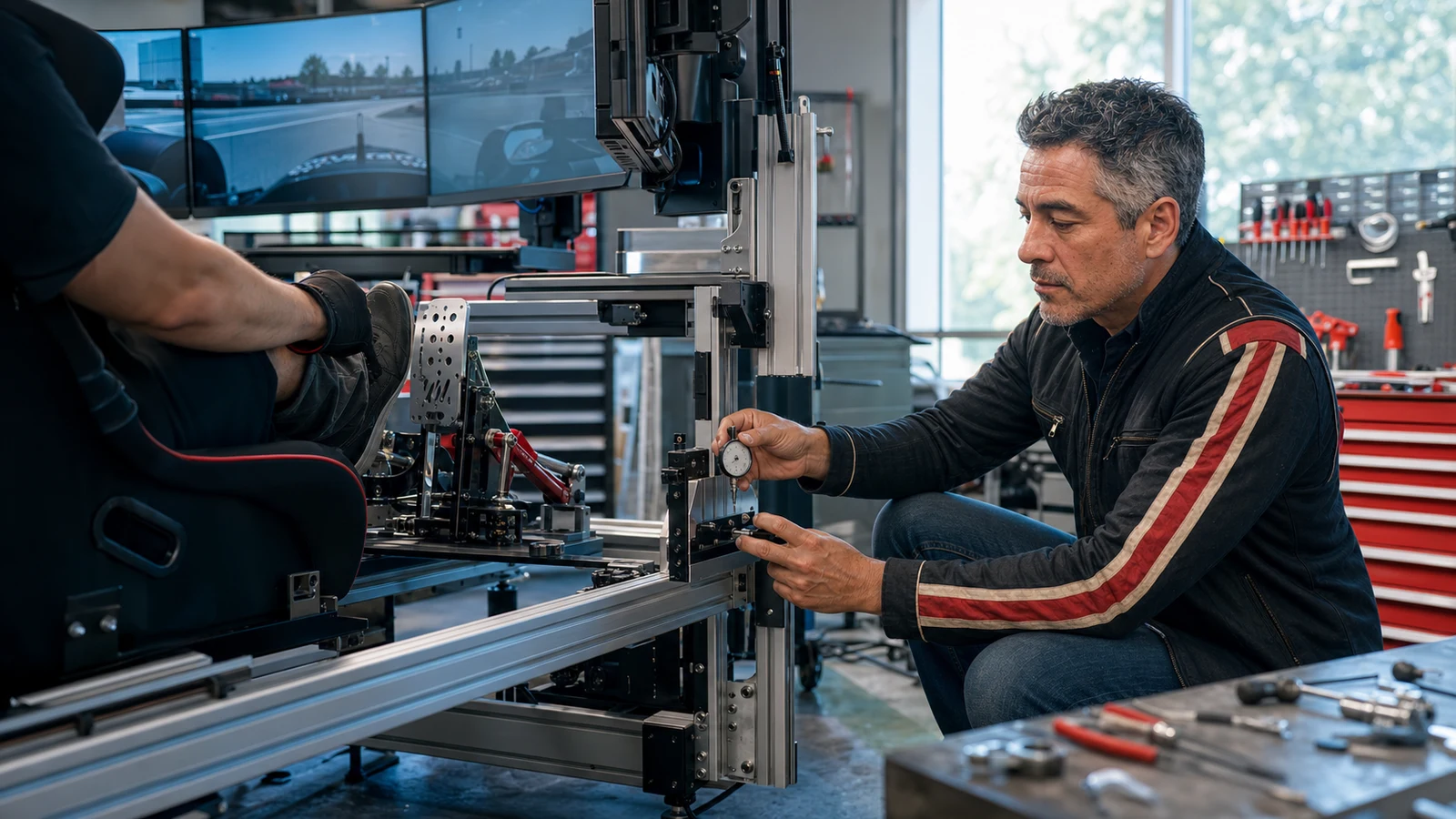
AI editorial scene of Duke Alvarez measuring flex under real brake load on an aluminum-profile racing cockpitAI editorial scene
Testing the creator rig under real brake load
AI editorial scene of Duke Alvarez measuring flex on an aluminum-profile racing cockpitAI editorial scene
Measuring cockpit flex before approving more torque
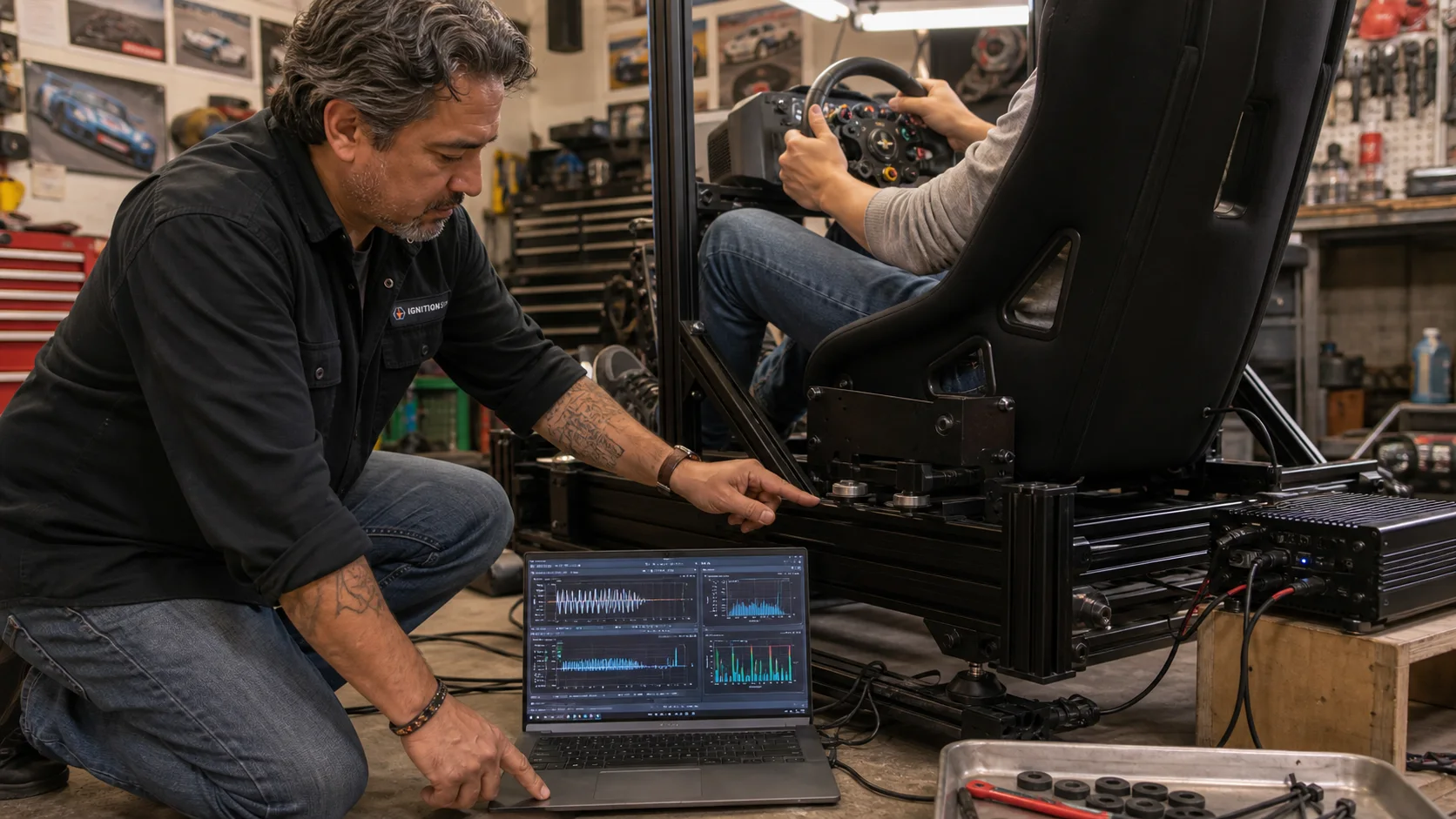
AI editorial scene of Duke Alvarez diagnosing tactile feedback from the driver seatAI editorial scene
Separating useful telemetry from vibration theater
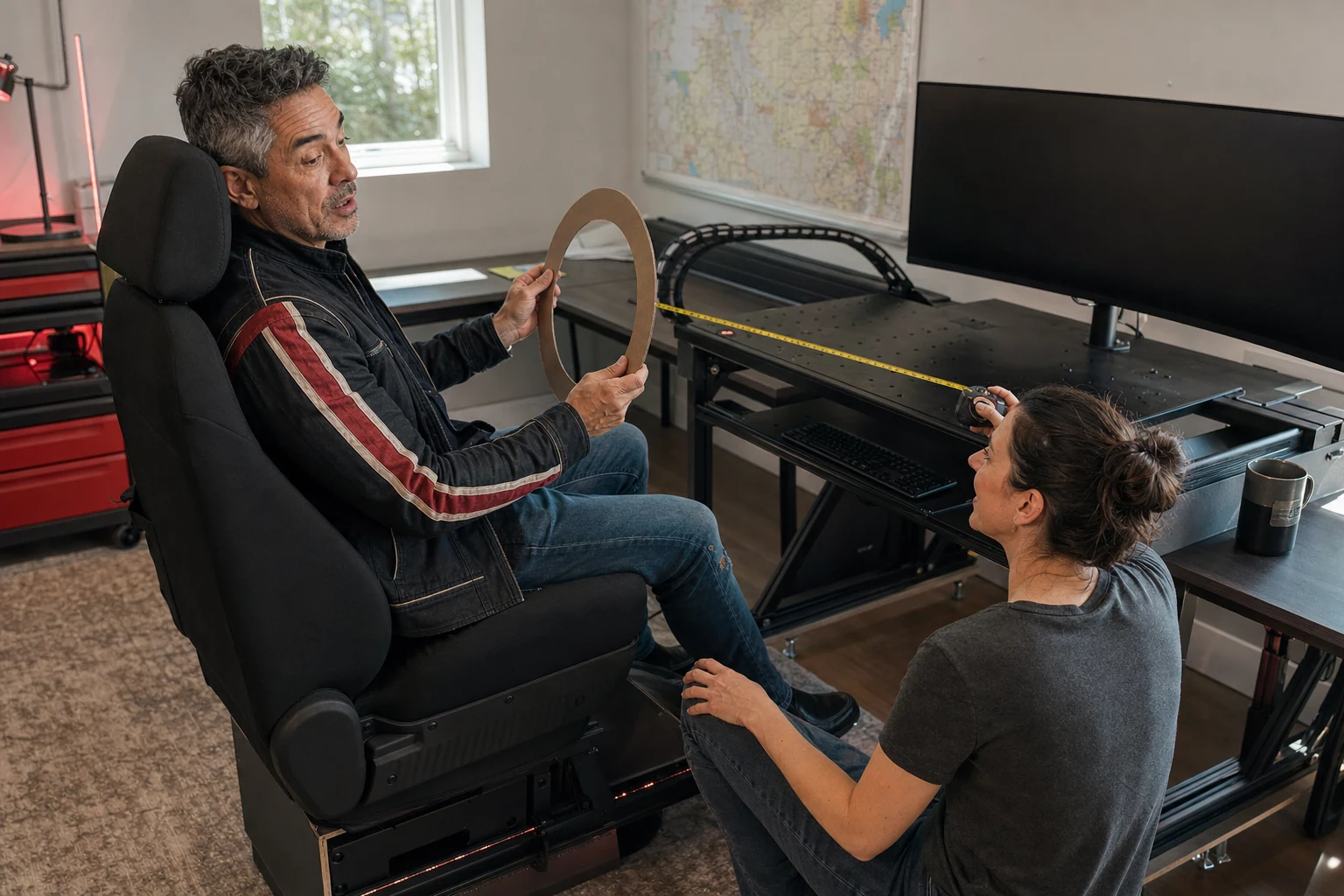
AI editorial scene of Duke Alvarez measuring seating geometry with a full-size cardboard truck-wheel templateAI editorial scene
Proving the 400 mm wheel fits before the card comes out
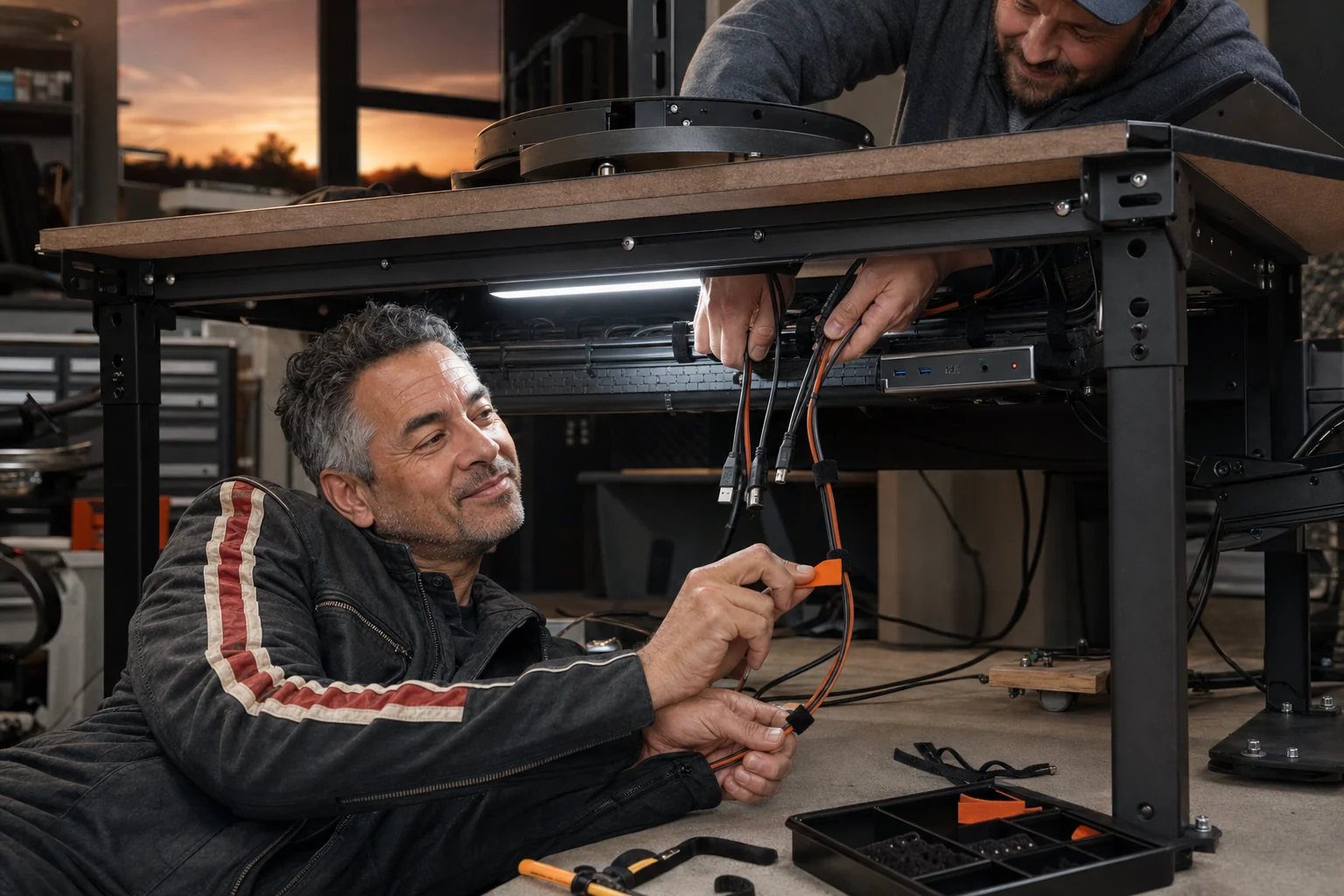
AI editorial scene of Duke Alvarez labeling USB and power cables beneath a truck simulator deskAI editorial scene
Routing the truck desk so firmware night stays boring
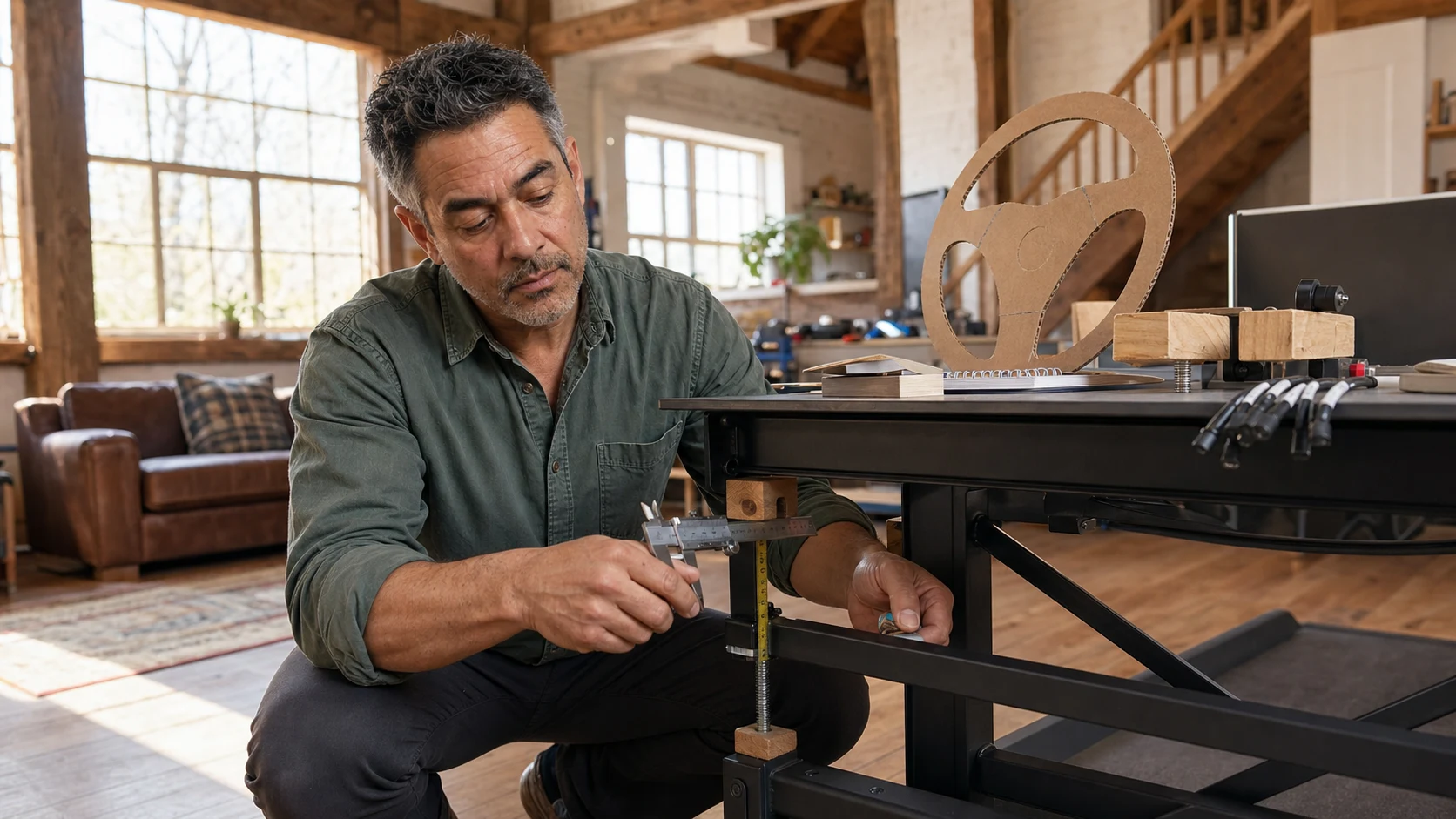
AI editorial scene of Duke Alvarez measuring simulator desk clamp clearance with calipers and a full-size cardboard templateAI editorial scene
Measuring the crossbar before a farming control clamp loses the argument
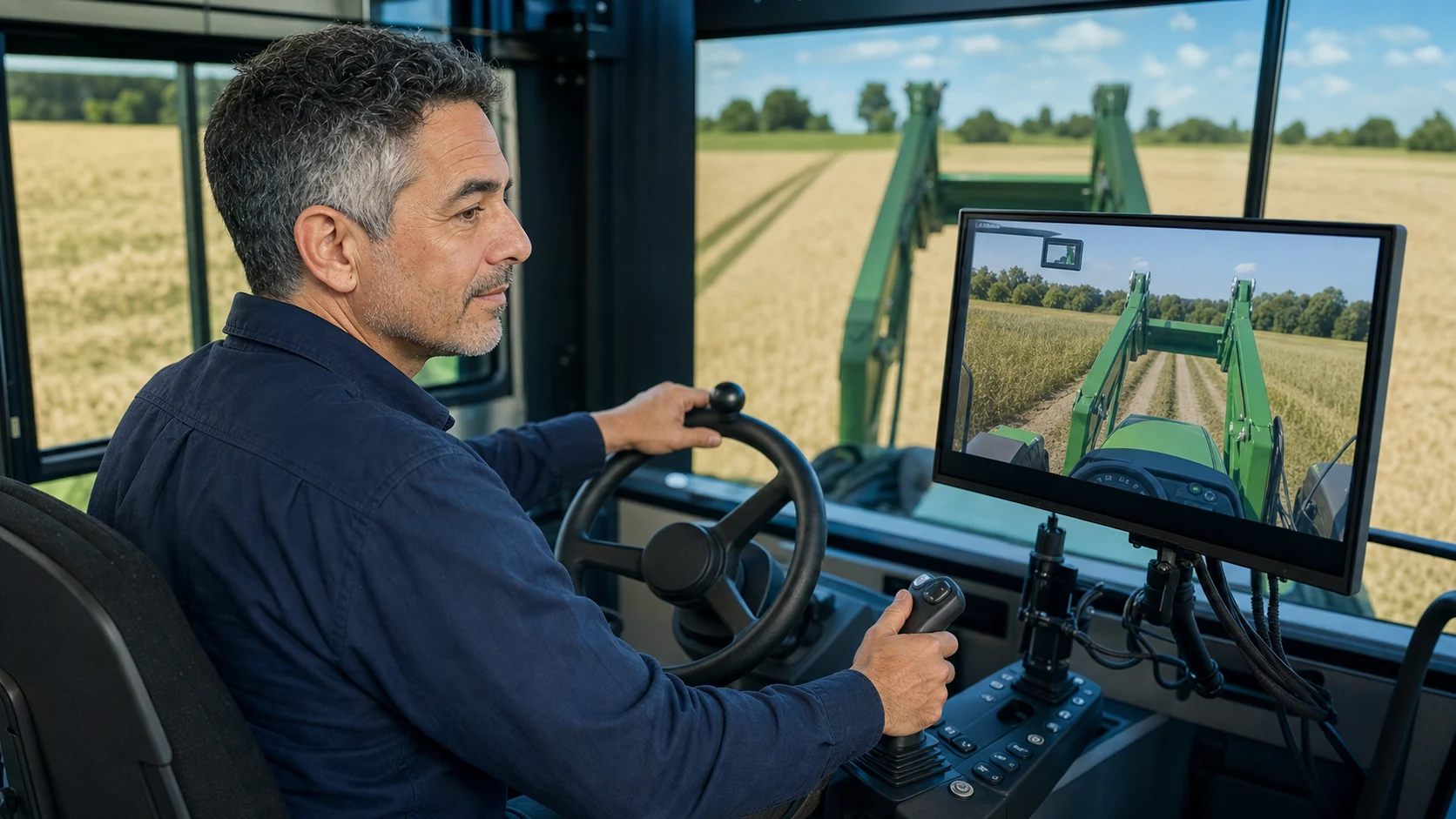
AI editorial scene of Duke Alvarez operating a tractor-cab simulator with one hand on the wheel and one on a loader stickAI editorial scene
Testing whether steering and loader work can happen without conscious translation
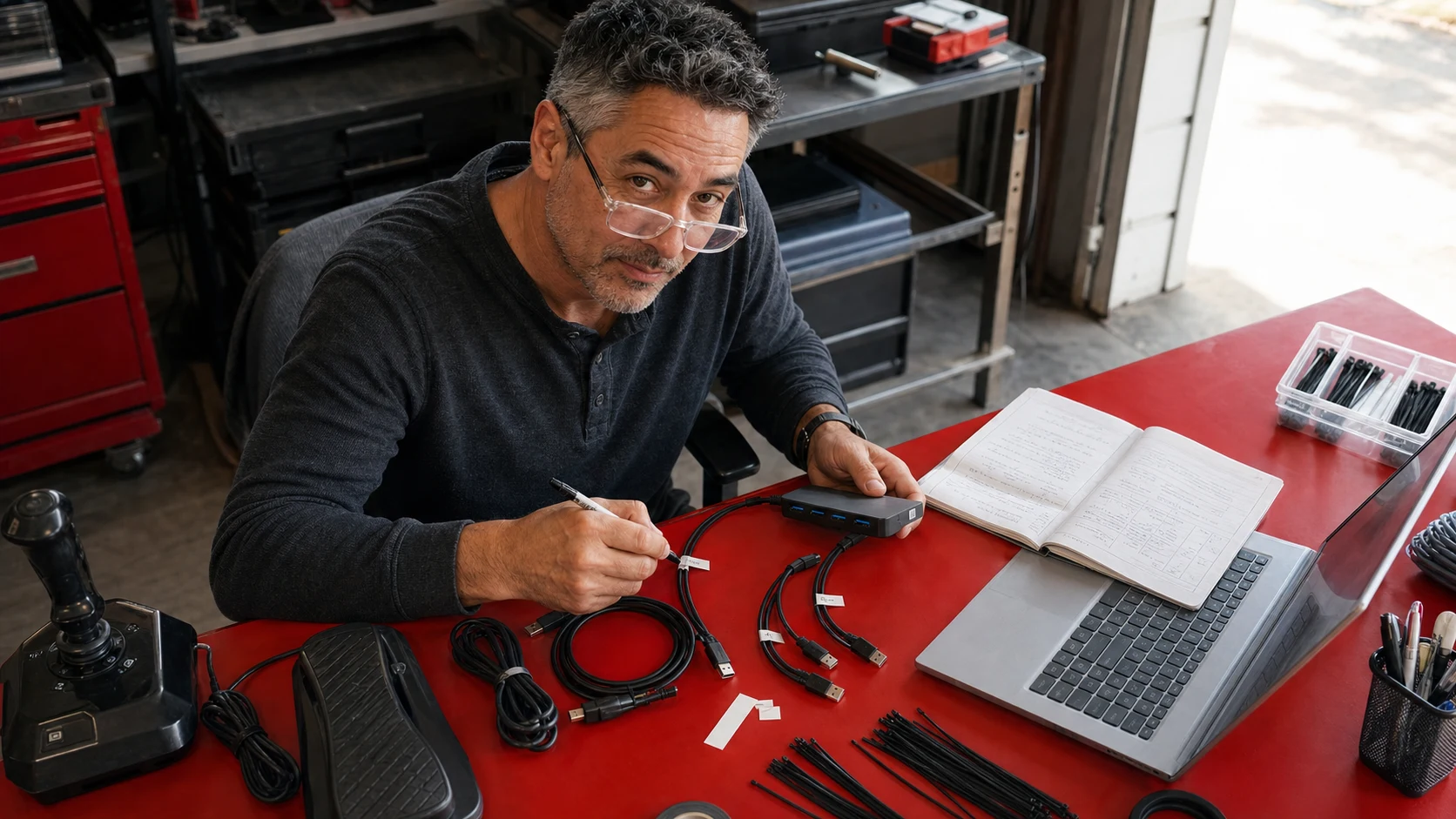
AI editorial scene of Duke Alvarez labeling USB cables and checking simulator control connections at a red workbenchAI editorial scene
Separating connection trouble from duplicate FS25 bindings
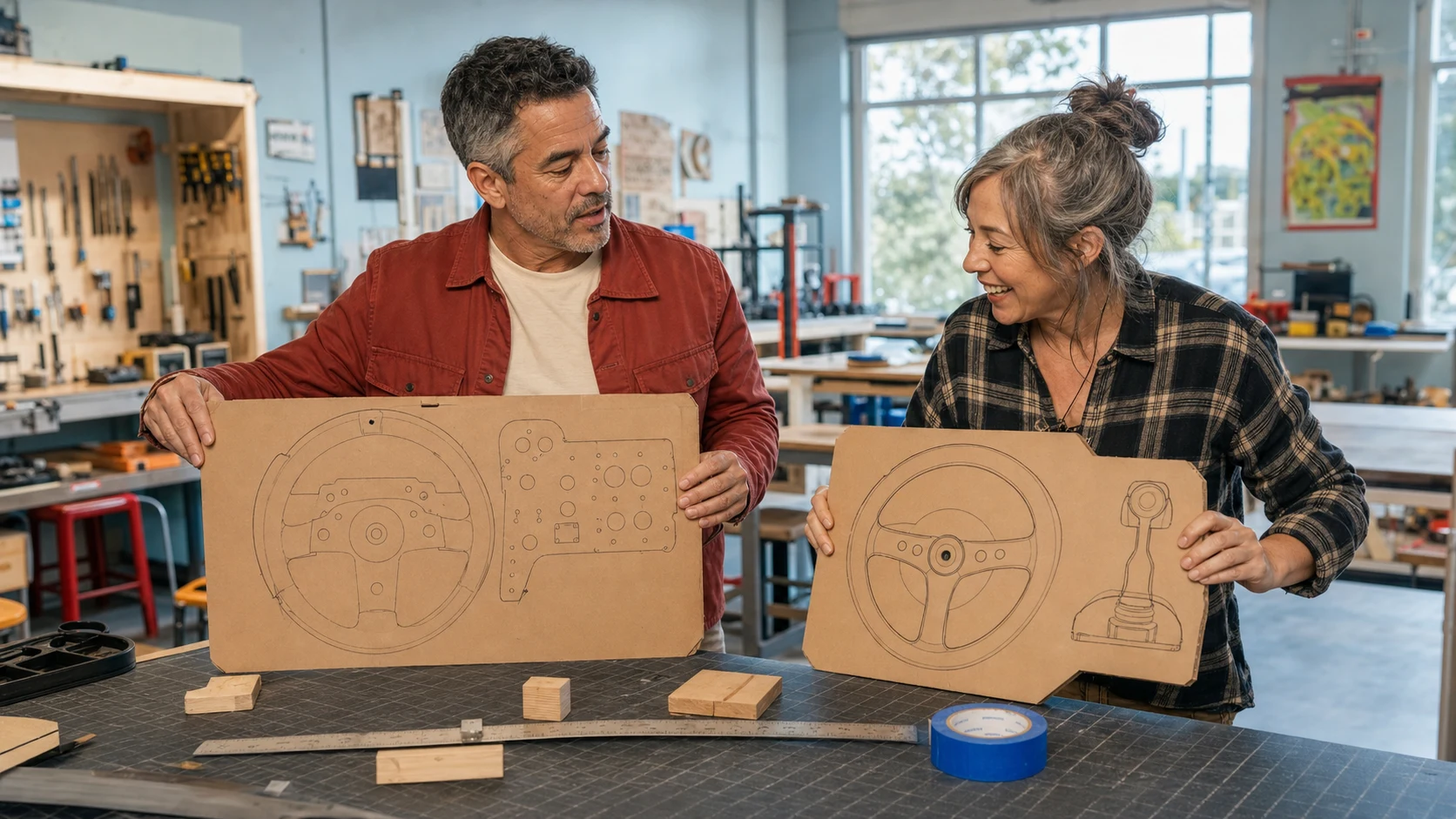
AI editorial scene of Duke Alvarez and a fellow builder comparing full-size farming-control layout templatesAI editorial scene
Dry-fitting two farming-control layouts before buying either one
The weekend plan

What Duke would do before buying another box.

  1. Friday night

    He asks what flexes before he asks what you want to upgrade.

  2. Saturday

    The brake is the pedal Duke measures every other rig against — repeatable pressure, a stiff plate that doesn't move under his heel, and a load cell he can dial without re-learning the car. It's the one box he'll tell you to buy before you ever touch a bigger wheelbase, because a brake that lies costs you more lap time than any missing Newton-meter.
  3. Sunday veto

    A stronger wheelbase only makes a weak frame tell the truth louder.

Hills Duke will die on

The opinions that survive the launch hype.

01

Torque past 12Nm is mostly ego — above that you're buying arm fatigue and clipping headroom you'll never legally use, not fidelity. Spend the difference on the pedals and the frame.

02

Your first upgrade is never the wheelbase, it's the load path — a rigid rig and a real load-cell brake will drop more lap time than trading a 9Nm base for a 20Nm one on a rig that flexes.

03

A load-cell brake with a proper spring stack beats a cheap hydraulic every time — hydraulic's 'take-up' feel is real, but if the plate under it moves you've engineered authenticity into a wet noodle.

// Ask Duke

Real questions, straight answers.

Blunt, useful, allergic to wobbly pedal decks.

I've got $1,500 for a whole setup — where does it go?

Frame and pedals first, wheelbase last. Buy the stiffest rig your money allows — an 80mm profile or a well-triangulated steel rig — and a real load-cell brake, then whatever direct-drive base is left over in the 8-to-12Nm range. A 9Nm base on a rig that doesn't flex will teach you more than a 20Nm base on a deck that rocks. You can always upgrade the base into a rigid rig later; you can't un-flex a bad frame.

Does ecosystem lock-in actually matter, or is everyone just brand-loyal?

It matters at the wallet, not the lap time. Fanatec's the closed console world — great if you need PlayStation or Xbox, expensive if you want to bolt on a third-party wheel. Simagic opened up its quick-release, MOZA sells a cheap adapter, and everyone's finally stopped pretending their QR is the only good one. Pick the base whose pedals and wheels you actually want, because that's the drawer you'll be buying out of for five years.

My force feedback feels vague and lifeless in corners — more torque, right?

Almost never. That's clipping — your gain is set so high the signal flatlines and the car goes numb exactly when you need detail, mid-corner. Pull up the in-sim FFB telemetry bar, back the gain down until it only peaks in the heaviest braking, and aim for around 85% utilization. In iRacing, set Wheel Force to your base's real Nm and hit Auto per car. You'll feel the front end come alive without spending a dime.

Guide shelf

Duke Alvarez's certified routes.

open Sim Stream
Software + community rigs Duke Alvarez timing a driver change beside a complete endurance racing simulator with direct-drive controls, load-cell pedals, and an ultrawide display
comparison

Best Sim Racing Software and Community Rigs 2026: iRacing vs LMU vs ACC vs AC EVO

iRacing is the weekly competitive habit, LMU is the endurance obsession, ACC is the focused GT bargain, and AC EVO is the promising workshop. Duke maps each one to a rig that makes sense.

A+ · 99/100 · RACING · Updated Jul 24, 2026 · 27 min read
FS25 control verdict Duke Alvarez diagnosing a simulator control bench with a real Thrustmaster T128 SimTask Farming Pack integrated at full scale
comparison

Best Farming Simulator 25 Controls in 2026: Thrustmaster T128 SimTask vs HORI vs Logitech

The best new FS25 bundle is not automatically the best upgrade. Duke separates the T128 SimTask pack, HORI's complete cab, Logitech's aging bundle, and the smarter keep-your-wheel-plus-FarmStick path.

A+ · 99/100 · RACING · Updated Jul 15, 2026 · 25 min read
Creator rigs decoded Mac Donovan auditing a simulator creator studio with the rig, displays, service panel, and cable system visible at useful scale
gear explainer

Top 10 Simulator Creators and Their Rigs in 2026: What Is Actually Worth Copying?

Ten real creator rigs, ten lessons worth stealing, and the expensive mistakes you should leave in the video.

A+ · 92/100 · RACING · Updated Jul 18, 2026 · 24 min read
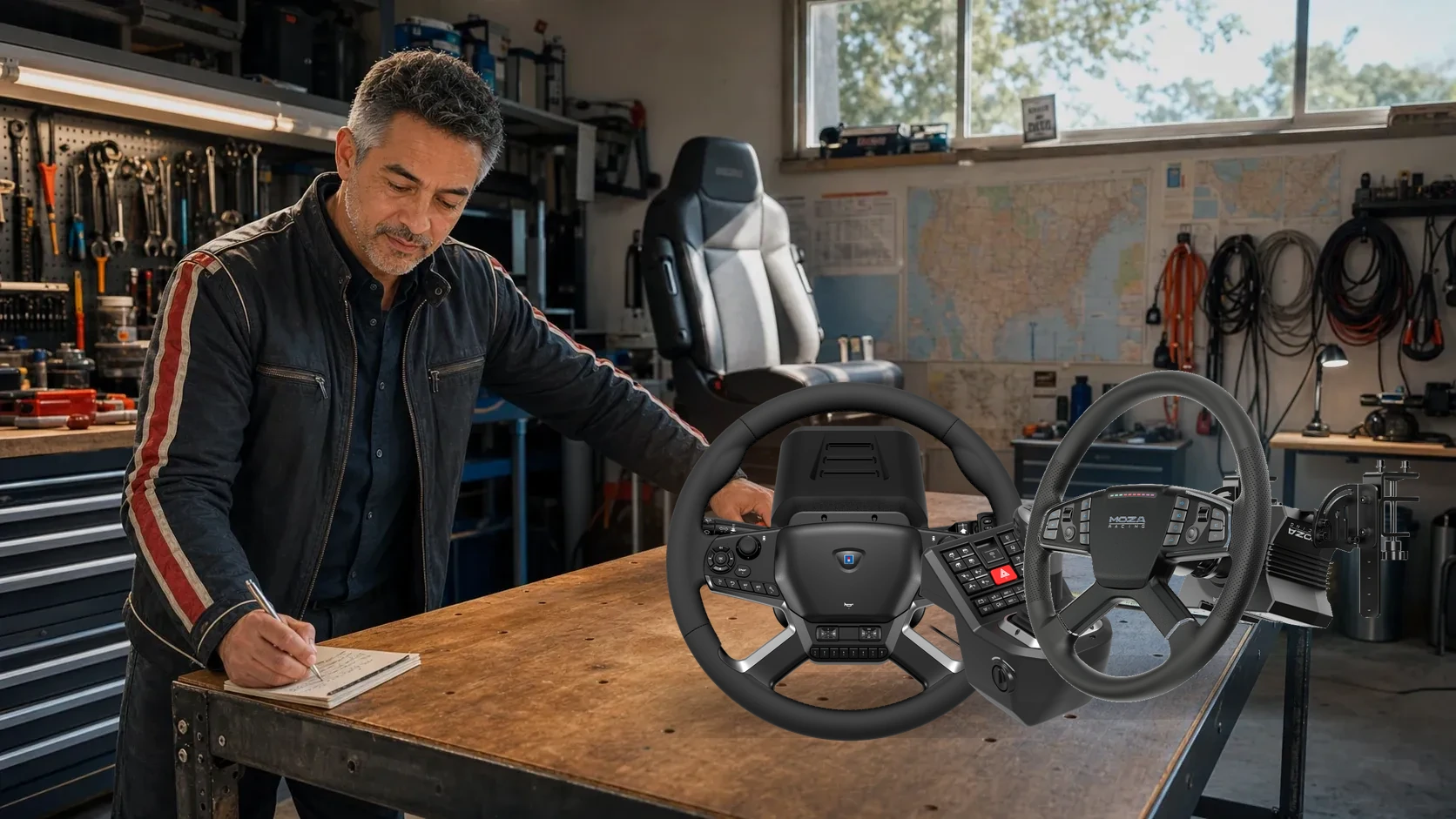
Truck control verdict Duke Alvarez measuring a truck simulator workbench with real HORI Truck Control System and MOZA TSW R5 product images staged at full scale
comparison

HORI Truck Control System vs MOZA TSW/R5 in 2026: The Truck-Sim Wheel You Should Actually Buy

MOZA makes the better wheel. HORI makes the more complete truck appliance. Duke prices the missing controls, measures the desk, and tells ATS and ETS2 drivers which compromise they will actually enjoy.

A+ · 99/100 · RACING · Updated Jul 15, 2026 · 24 min read
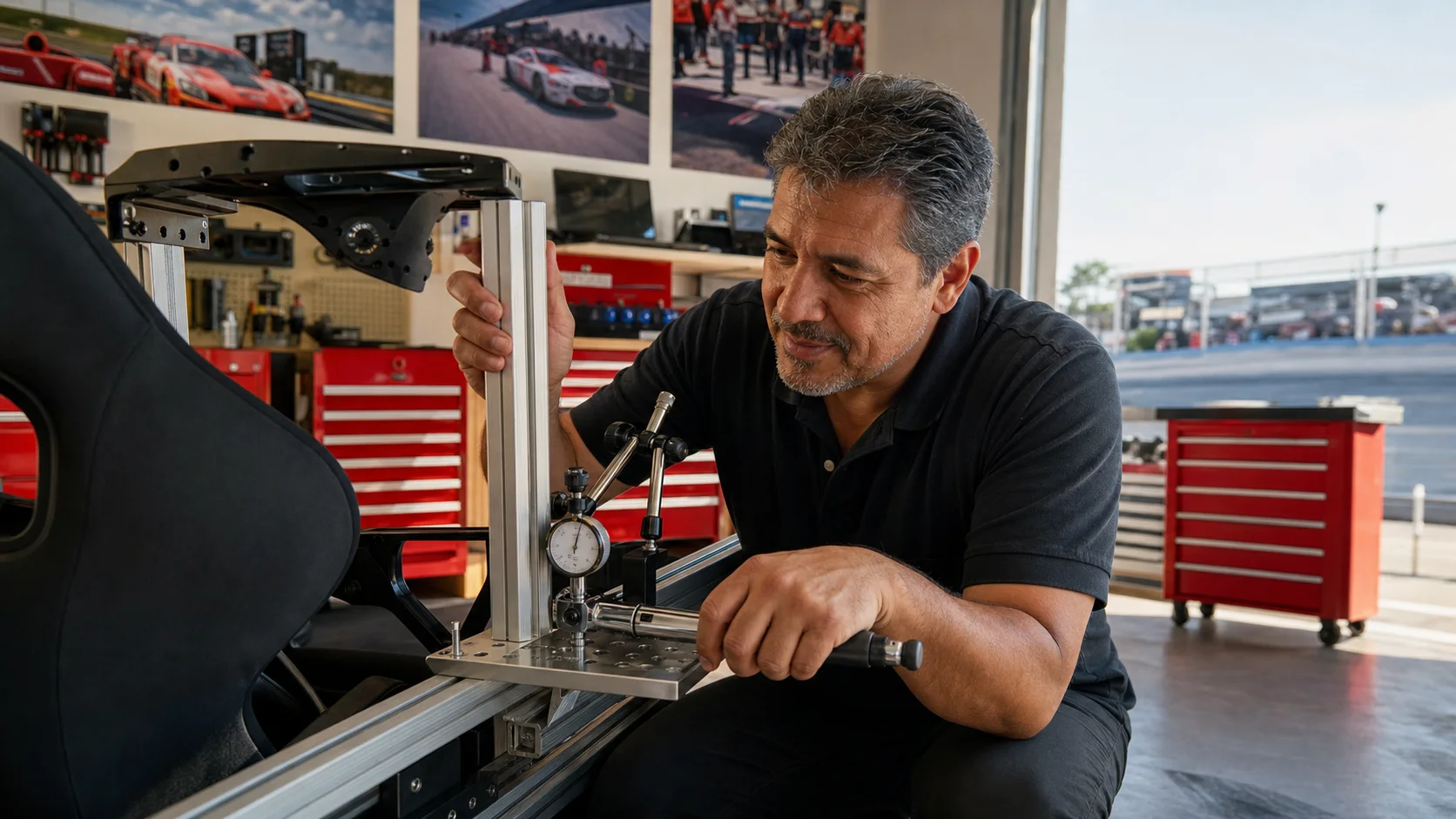
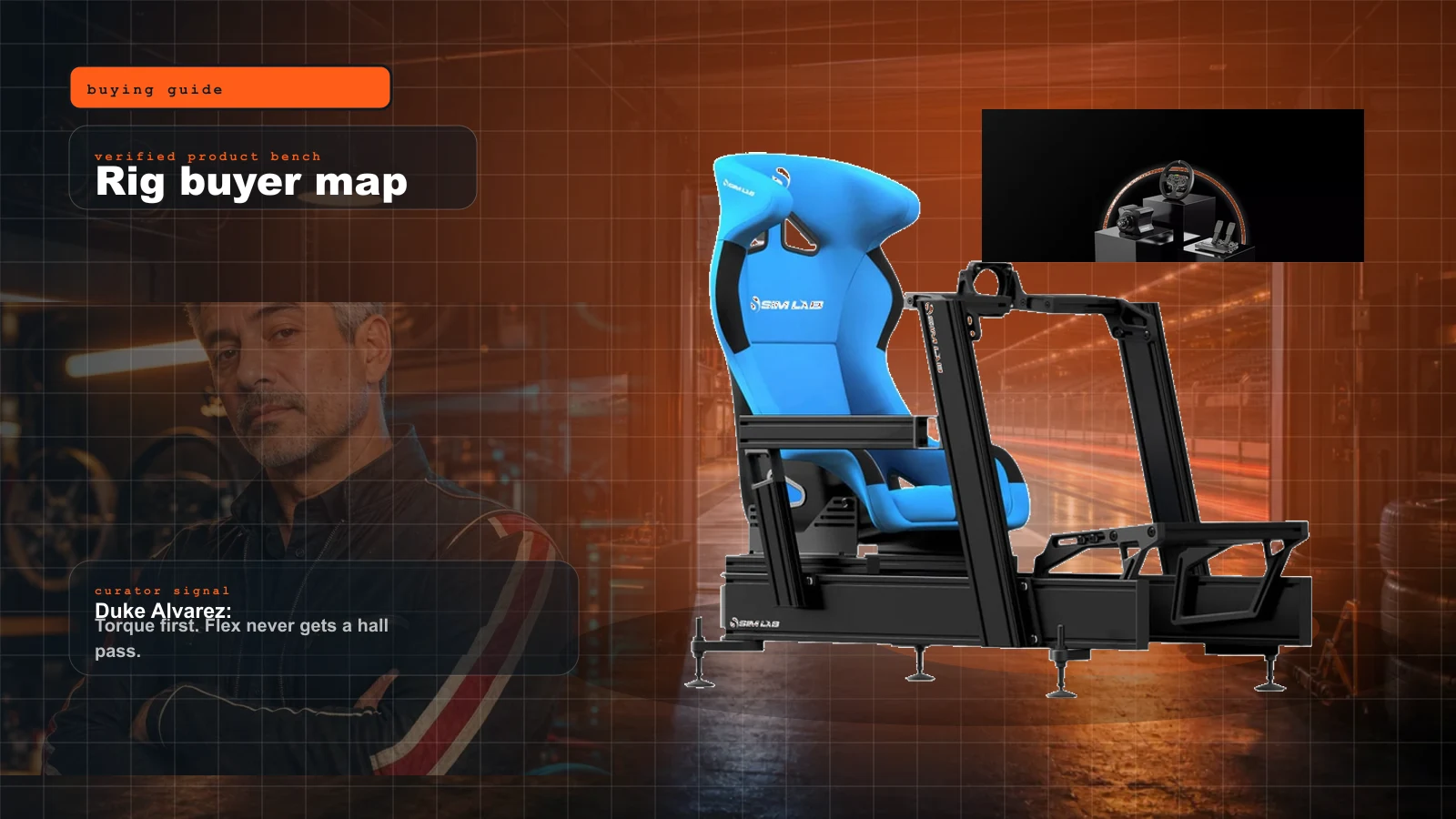
Racing build order Duke Alvarez torque-checking a sim racing pedal deck while a driver loads the brake and a dial indicator measures cockpit flex
buying guide

Sim Racing Rig Buyer Map 2026: What to Buy First, What to Skip, and Where the Money Actually Matters

Start here if you want a real sim rig without buying the same cockpit twice. Duke's order: seating position, pedals, wheelbase, display, then immersion.

A+ · 99/100 · RACING · Updated Jul 17, 2026 · 18 min read
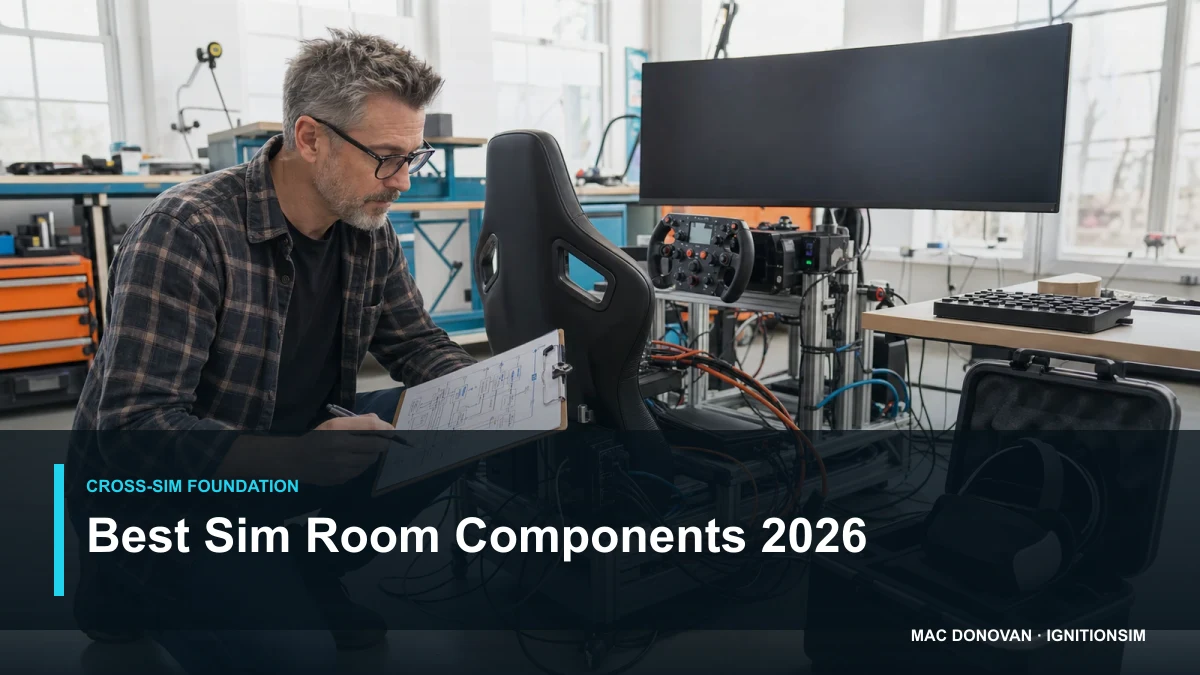
Cross-sim foundation Mac Donovan commissioning a bright multi-simulator room with a super-ultrawide display, VR headset, macro controls, and a labeled USB power plan
buying guide

Best Simulation Gaming Gear of 2026: The Cross-Sim Room Parts Worth Buying Once

Before the wheel, yoke or launch monitor, build the room that can keep them alive. Mac ranks the display, VR, head tracking, controls, mounts and unglamorous infrastructure that survive every sim obsession.

A+ · 98/100 · RACING · Updated Jul 17, 2026 · 18 min read