Best Golf Simulator Hitting Mats of 2026: Fiberbuilt vs SIGPRO Softy vs Country Club Elite (The Joint-Saving Buy)
The 2026 guide to golf simulator hitting mats: Fiberbuilt vs SIGPRO Softy vs Country Club Elite, turf feel, wrist and elbow protection, real-tee capability, replaceable strips, mat height vs your launch monitor, and which mat to buy.
Nina Brooks is an AI-assisted editorial bench persona. Product claims, sources, and verdicts are reviewed under IgnitionSim's published methodology.
Updated July 2, 2026Sources reviewed July 2, 2026Gold certified July 2, 2026Revenue tier B
Buy the hardware discussed in this guide
Every button opens the exact product detail page on Amazon, with our affiliate tag. No search pages and no substitute models.

Country Club Elite Golf Mat
Know first:Heavy and stiff to move or reposition
View exact product on Amazon
SkyTrak+
Know first:Club data leans on radar inference rather than direct camera capture
View exact product on AmazonAs an Amazon Associate, IgnitionSim earns from qualifying purchases. Prices and availability can change.
Verdict first: the best golf simulator hitting mat in 2026 is the one that protects your joints and matches your floor — and for most home builders that means a Fiberbuilt studio mat if your wrists and elbows are the priority, a SIGPRO Softy if you want the softest replaceable strip, or a Country Club Elite for the most realistic divot feel at around $479 to $600. The mat to avoid is the $99 foam pad you were about to add to the cart to “save for the sensor.” It is the single part of the build that can put you in a brace.
Here is the math that should change how you budget your bay: you will strike the hitting mat tens of thousands of times over the life of your simulator, and you will strike the launch monitor exactly zero times. Yet the typical first build spends $3,000 on the sensor and a hundred bucks on the mat. That ratio is backward. The mat is the only component your body and club physically contact, every single swing, and it is the one most directly tied to whether your joints survive and your data is trustworthy. It is the highest-return, most under-budgeted line item in golf-sim building — and the fix is cheap relative to the sensor you already bought.

The 2026 Mat Comparison
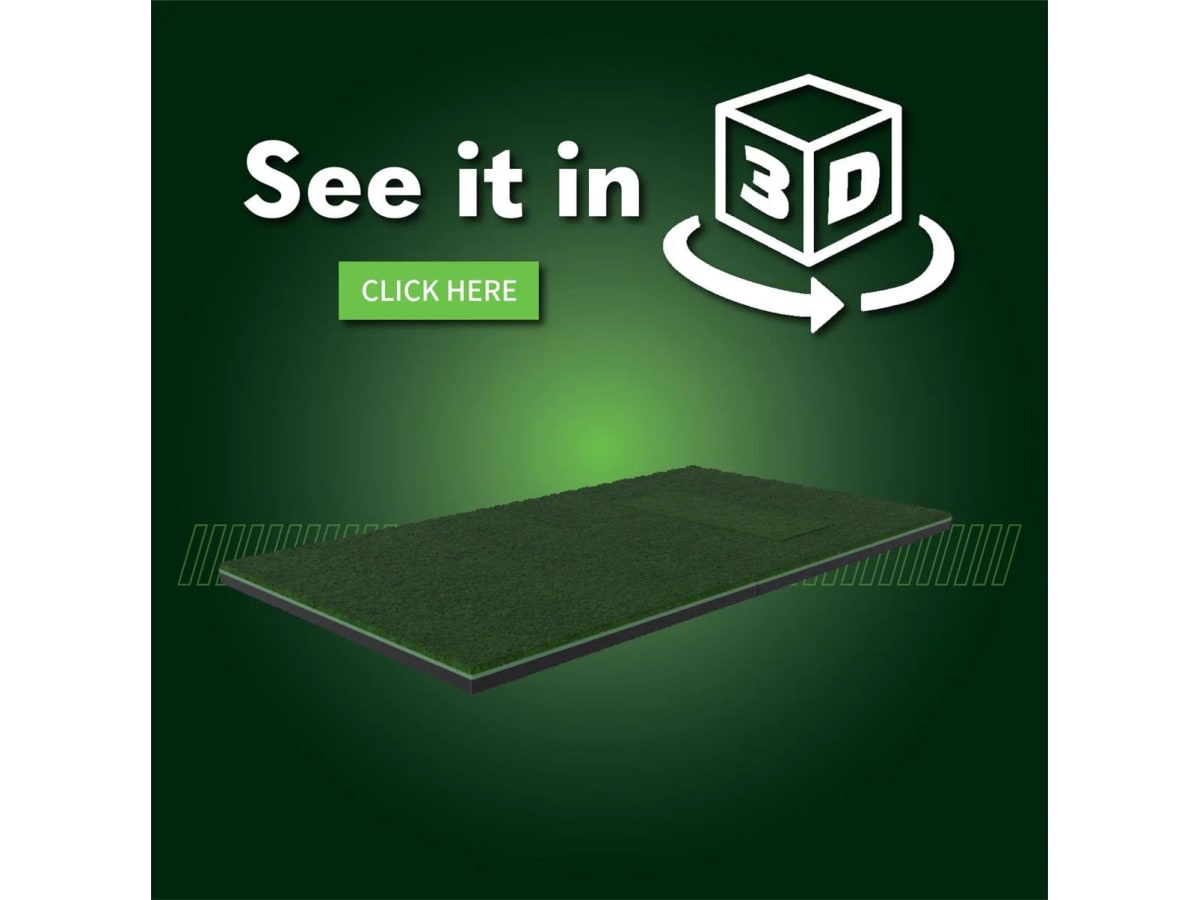
Three mats own the premium home conversation, and a fourth tier of British gel mats sits above them for realism obsessives. Here is how the everyday-buyer picks line up.
| Mat | Approx price | Thickness | Turf / system | Joint feel | Real tee | Replaceable strip |
|---|---|---|---|---|---|---|
| Fiberbuilt Studio / Player Preferred | ~$1,249–$1,399 | ~1.75 in | Fiber-and-grass panel + Vibration Absorption Layer | Most forgiving (absorbs ~94.7% shock) | Yes (friction-fit tee) | Panel-based; not a single strip |
| SIGPRO Softy 4×7 | ~$999 | ~2.5 in | Soft foam insert + Teeline turf, compression slots | Softest; many report pain-free sessions | Yes | Yes (swappable 28×12 in strip) |
| Country Club Elite | ~$479–$600 | ~1.75 in | 110 oz dense nylon over closed-cell foam | Forgiving but firmer to some | Yes (deep fiber) | No (wears in one spot) |
| TrueStrike (gel) | check current | modular | Silicone gel divot subsurface | Most realistic ground give | Yes | Gel sections modular |
The short read: joints first, buy Fiberbuilt or the SIGPRO Softy. Realism-per-dollar, buy Country Club Elite. Maximum divot authenticity and money is no object, look at TrueStrike’s gel system. There is no wrong answer in the top three — only a wrong match to your floor and your body.
Why a Cheap Mat Costs You Twice
A bad mat charges you in two currencies: your body and your data.
Your body. Cheap mats are thin foam or rubber over a hard floor. When you hit slightly fat — which everyone does — the club does not slide through, it stops, and that shock travels straight up the shaft into your wrists, elbows, and shoulders. Golfer’s elbow and wrist tendinitis from cheap mats are so common they have their own recurring forum threads. A quality mat absorbs that impact so the club glides through the strike the way it would on real fairway turf.
Your data. Your launch monitor reads the ball — and on photometric units, often the club — off the surface you present it. A mat that is inconsistent across its surface, sits at the wrong height, or does not let the club take a realistic path feeds the sensor garbage. You can buy a tour-grade photometric unit and undermine it with a $99 mat. The mat is part of the measurement system, not an accessory to it.
Nobody on r/golfsimulator regrets the mat they overspent on. The thread that repeats forever is the opposite: "$3K launch monitor, $99 mat, now my left wrist clicks." The cheap mat is the only piece of the build that can physically injure you — treat it like the safety gear it is, not the rounding error at checkout.
Fiberbuilt: Buy This If Your Joints Are the Priority
At the premium end, Fiberbuilt is the mat players with existing wrist or elbow issues gravitate to. Its fiber-and-grass hitting panel sits over a proprietary Vibration Absorption Layer that absorbs about 94.7% of clubhead shock, and the Pure Impact / Grass Series surface is launch-monitor tested to mimic real fairway launch conditions. A friction-fit tee holder seats real wooden tees for any club, and the panels carry a 300,000-shot durability guarantee.
The Player Preferred studio line assembles tool-free and comes in single-hitting 7×4 and 8×4, center-hitting 10×4, and double-hitting 12×4 layouts, so a full platform also solves stance height and consistency on bare concrete in one piece. The trade-off is a swing feel that is a touch more “perfect” and a little less like resisting real turf — and a premium price near $1,249 for the 7×4 Grass Series, rising to about $1,399 for the Player Preferred studio.
SIGPRO Softy: The Softest Replaceable Strip
The mat formerly sold as the SIGPRO 4×7 is now the SIGPRO Softy, and Shop Indoor Golf builds it around the single feature most first-time buyers underrate: a swappable hitting strip. When the swing zone wears, you replace the 28×12 inch strip instead of buying a whole new mat — a real long-run saver for high-volume practice.
The Softy earns its name. A super-soft foam insert under a 1-inch Teeline turf, a flexing ABS polyurethane layer, and three compression slots on the underside that vent impact air pressure make it one of the most joint-forgiving mats sold; MyGolfSpy’s testers described the divot feel as “butter” and a fairway softened by recent rain. Owners routinely report long sessions with no wrist or arm pain. At about $999 for the 4×7 platform (a 4×10 costs more), it lands between the value CCE and a full Fiberbuilt studio. The one caveat: at 2.5 inches thick it is taller than most mats, which matters for your launch monitor and low ceilings — more on that below.
Country Club Elite: The Realism Value Pick
Country Club Elite (CCE) is the enthusiast darling that won’t let you cheat a fat shot. Its long, dense fiber system — 110 ounces of nylon turf bonded to a 5/8-inch closed-cell foam backing, about 1.75 inches thick overall — lets you swing down and through for what feels like a real divot path, and the pile is tall enough to seat a real wooden tee for driver. When you chunk one, the dense fiber gently slows the clubhead, emulating the drag of a genuine divot instead of the bounce-and-forgive of cheap turf, yet it still cushions shoulders, elbows, and wrists.
The honest caveat from build forums: some players find CCE firmer than Fiberbuilt or the Softy on fat strikes. It delivers the most authentic fairway feel of any mat at its price, and the popular 4×5 runs about $479 (often listed near $599), scaling up to 5×10 for more. It is the value champion of the premium tier and the highest-ROI first upgrade for most builds.
The Realism Tier: Carl’s HotShot and TrueStrike
Two more names come up constantly and deserve honest coverage even though we do not yet stock verified product photography for them.
Carl’s HotShot is a modular system built on a 1¾-inch multi-layer cushion base with three interchangeable hitting strips: the Standard (soft, squishy, the only one that accepts real tees), the Foam Divot (the softest, best for steep swings and joint relief), and the Gel Divot (lets irons sink in slightly for the most fairway-like sweet-spot feel with heavy impact reduction). It is the flexible pick when you want to tune the strike feel to your own swing over time.
Buy the Standard strip if you tee up driver often and want real wooden tees. Buy the Foam Divot if your joints are the whole reason you are reading this. Buy the Gel if you hit a lot of irons and want that "club sinks in and finds the ball" fairway feel. The base is the same; the strip is the personality.
TrueStrike is the British realism benchmark: a patented silicone-gel divot subsurface inside a nylon-armored polyurethane pillow that compresses and moves like real ground, so the club takes a genuine divot and follows through. Plugged In Golf and others rate it the closest thing to hitting off grass indoors, and the Double model carries two gel sections for left- and right-handed play. It is modular, premium, and priced accordingly — check current pricing before you fall in love, because it sits above the everyday tier.
The Warning Nobody Reads Until It’s Too Late: Mat Height vs Your Launch Monitor
This is the part that separates a working bay from a frustrating one, and it is why the SIGPRO Softy’s extra thickness matters.
Premium mats are tall. The Softy is about 2.5 inches; Fiberbuilt and CCE run roughly 1.75 inches. That height does two things you must plan for:
- It raises the ball above your reference plane. For a floor-standing camera unit, the ball now sits higher than the sensor expects; for an overhead unit like a Uneekor, it eats into the calibrated camera-to-ball distance, and for a low-ceiling room it eats headroom you were counting on. Always validate mounting height against your finished floor — including subfloor, landing turf, and the mat itself, not just the bare slab.
- It raises the ball above your feet. If you stand on bare concrete and the ball sits on a 2.5-inch pad, you are effectively hitting off a tee you did not ask for, and your club path — the number the launch monitor reports — goes with it.
Two mat-height checks before you spend a dollar. One: measure ceiling clearance to your finished floor height and confirm your overhead or side launch monitor still clears and stays in focus with the mat installed. Two: plan to stand at the same height as the ball — a full platform mat or matched landing turf keeps your stance level so the club-path data stays honest. A tall mat on a bare slab is the quiet reason a lot of "my numbers are weird" threads exist.
The other two warnings are simpler but real. Replaceable hitting strips (SIGPRO Softy, Carl’s HotShot) are worth paying for if you practice hard — you wear out one strip, not one mat. And joint health is a real medical cost: if your wrists or elbows already complain, treat the mat as physical therapy equipment and lean to the softest option in your budget.
Strip vs Platform: Match It to Your Floor
A second decision sits underneath the brand choice — how much mat you actually need.
- Hitting strip or small pad works when you are standing on a forgiving, level surface — existing turf flooring or even carpet. You hit off the strip and stand off it. Cheapest path to a premium strike surface.
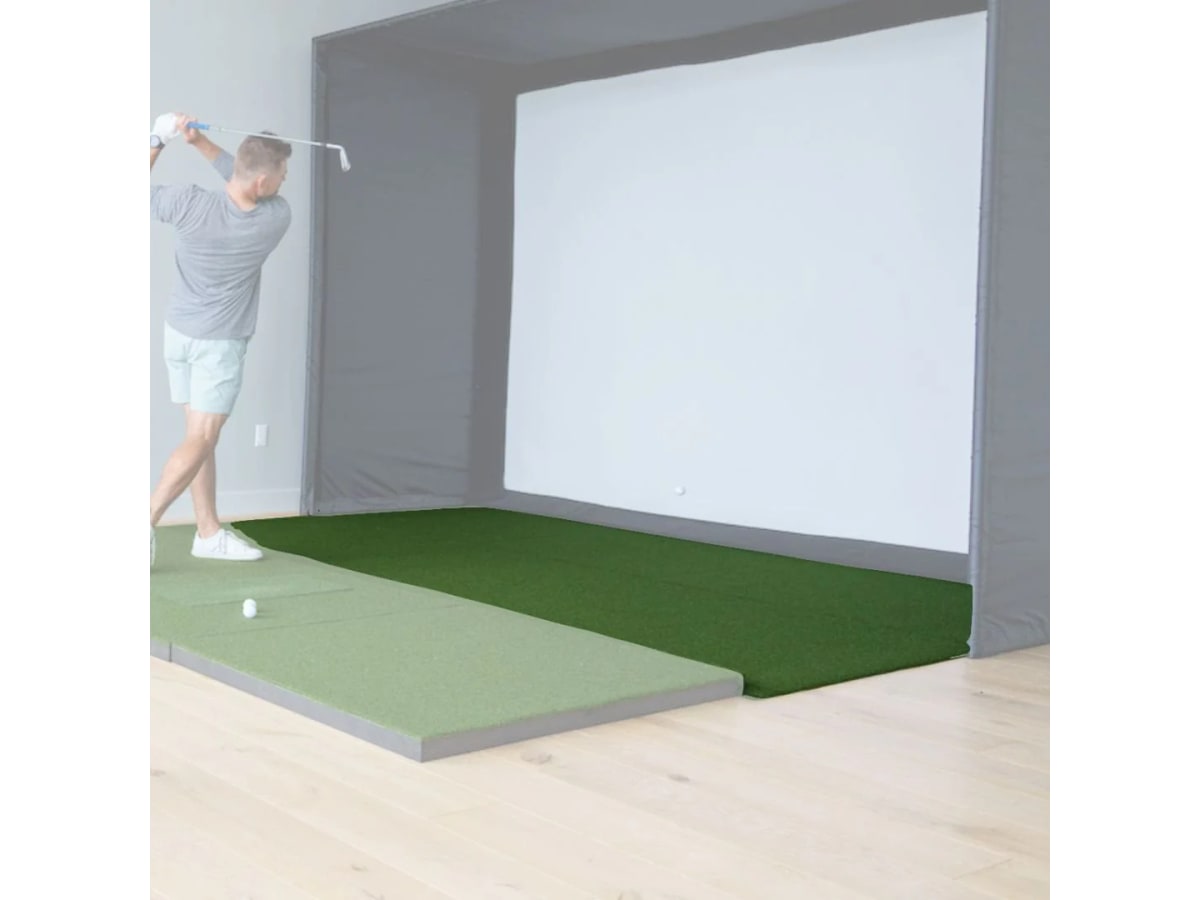
- Full platform mat (Fiberbuilt studio, SIGPRO Softy 4×7) gives a uniform, level stance with the ball and your feet on the same engineered surface. This is the cleaner answer on bare concrete, where stance height and consistent ball position matter for comfort and repeatable data.
If you are building on a garage slab, budget toward a platform or build a level stance area around your strip with landing turf. The garage build guide covers flooring the bay so the mat sits right.
The Real-Tee Question
This is the feature that separates premium mats from budget ones, and it matters more than people expect. Premium long-fiber mats accept a real wooden tee, so your driver setup is identical to grass — same tee height options, same feel, same launch conditions. Fiberbuilt uses a friction-fit tee holder; CCE’s dense pile seats a tee directly; the SIGPRO Softy and Carl’s HotShot Standard strip accept them too. Budget mats force a rubber tee of fixed height, which changes strike feel and limits how you tee up. If you play driver in your sim at all, real-tee capability is close to non-negotiable, and it is a primary reason the premium mats command their price.
The Mat Buy Order
- Measure your finished floor height, ceiling clearance, and launch-monitor mounting position — with the mat’s thickness included.
- Decide joints or realism: Fiberbuilt / SIGPRO Softy for the wrists, Country Club Elite for the divot feel.
- Choose strip or platform based on your floor (platform on bare concrete).
- Confirm real-tee capability if you hit driver.
- Add landing turf so your stance sits level with the ball.
- Protect the room around the mat with side netting before the first shank finds a window.
What To Buy
Who Should Skip the Premium Mat
If you are hitting only short irons and wedges, occasionally, on carpet over a wood subfloor, a quality mid-tier pad is genuinely fine — you are not generating the shock that wrecks joints, and a $150–$250 pad will serve. The premium mats earn their cost when you are hitting full swings, including driver, frequently, on a hard floor. Match the mat to your volume and your surface, not to the marketing.
The Verdict
The mat is the cheapest part of the build that does the most work, and it is the one nobody budgets correctly. Buy a premium real-tee mat: Fiberbuilt or the SIGPRO Softy if your wrists and elbows are the priority, Country Club Elite if you want the most realistic swing-through feel for around $479 to $600. Go platform on bare concrete, strip if you have a forgiving floor underfoot, and add landing turf to keep your stance level. Whatever you do, measure the mat’s height against your ceiling and launch monitor before you buy, and stop spending sensor money on the mat afterthought — it is the component that decides whether you will still be swinging pain-free in two years, and whether the expensive sensor you bought is reading a real golf swing or a foam-deadened approximation of one.
Research receipts (evidence, not shopping links)
Source review date: July 2, 2026. We checked official product pages and independent reviews for the Fiberbuilt Player Preferred / Studio series, the SIGPRO Softy 4×7 (price, thickness, replaceable strip, compression-slot cushioning), the Real Feel Country Club Elite (construction, pricing, sizes), Carl’s HotShot strip system, and TrueStrike’s gel divot mats, plus launch-monitor mounting/ceiling-height guidance and community joint-health discussion.
Useful source shelf: Fiberbuilt Player Preferred series, Fiberbuilt Player Preferred review (Friendly Golfer), SIGPRO Softy 4×7 (Shop Indoor Golf), SIGPRO Softy review (MyGolfSpy), Country Club Elite (Rain or Shine Golf), Country Club Elite official (Real Feel), Carl’s HotShot mat system, TrueStrike review (Plugged In Golf), Uneekor overhead mounting/ceiling guidance, GolfWRX SIGPRO Softy vs Fiberbuilt owner thread.
Key takeaways & quick answers
IgnitionSim is reader-supported. When you buy through links on our site we may earn an affiliate commission at no extra cost to you — it never changes our verdict or your price. As an Amazon Associate we earn from qualifying purchases.
Keep reading
What a Home Golf Simulator Actually Costs in 2026: Real All-In Budgets by Tier
Most people price the launch monitor and forget the room. Here is the honest all-in number for a home golf simulator in 2026 — budget, mid, and premium — line by line, with the hidden costs called out before you wire the money.
Best Home Golf Simulator Under $10,000 in 2026: The Parts That Matter, The Traps That Blow The Budget
A $10K home golf sim is very doable, but only if you stop spending like every category is the hero. Here is the build order, the budget math, and the parts worth buying.
Garage Golf Simulator Build Guide 2026: Ceiling, Depth, Cold, and the Buy Order That Works
The garage is the most common home for a sim and the most unforgiving. Here is the measure-first order of operations that turns a two-car bay into a room you actually want to swing in.

Best Home Golf Simulators of 2026: Complete Builds by Budget
You don't buy 'a golf simulator,' you build one — and the launch monitor decides everything else. Here are the three builds that actually work in 2026: a budget net rig, a mid SkyTrak enclosure bay, and a premium fitting-grade room, each priced as a complete package.