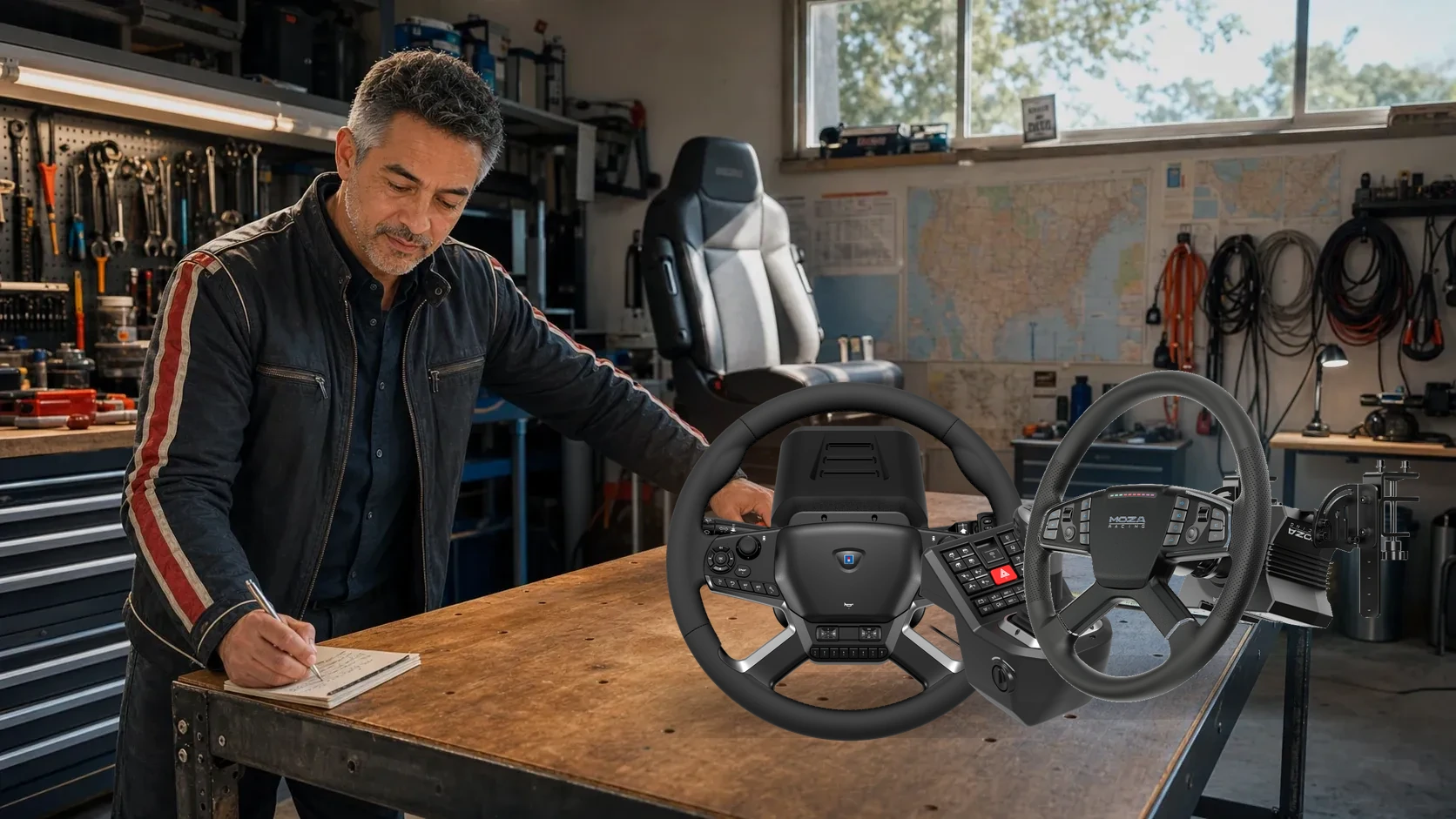
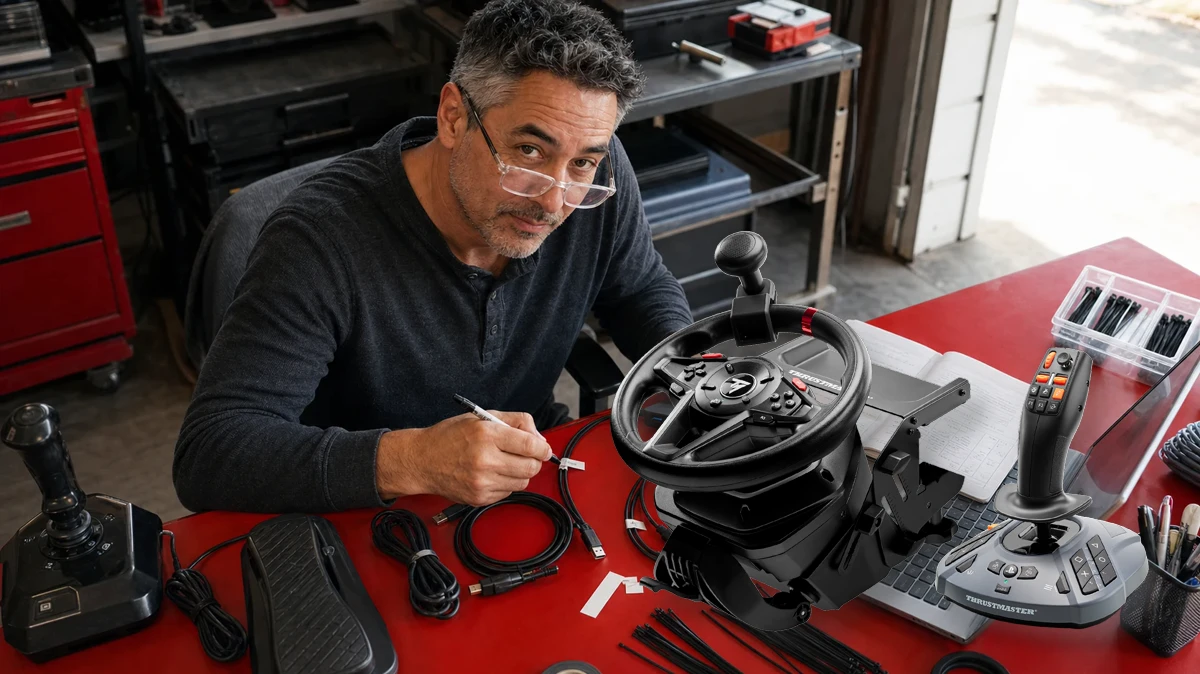
 AI-assisted editorial composite
 HORI Truck Control System vs MOZA TSW/R5 in 2026: The Truck-Sim Wheel You Should Actually Buy
HORI Truck Control System vs MOZA TSW and R5 Trucking Bundle: force feedback, 1800-degree steering, shifter, stalks, pedals, desk fit, setup traps, owner feedback, and the best ATS or ETS2 buy.
Duke Alvarez is an AI-assisted editorial bench persona. Product claims, sources, and verdicts are reviewed under IgnitionSim's published methodology.
Updated July 15, 2026Sources reviewed July 15, 2026Gold certified July 15, 2026Revenue tier A
Buy the hardware discussed in this guide
Every button opens the exact product detail page on Amazon, with our affiliate tag. No search pages and no substitute models.

As an Amazon Associate, IgnitionSim earns from qualifying purchases. Prices and availability can change.
Fast verdict: buy the MOZA R5 Trucking Bundle if steering feel, build quality, other driving sims, and a long upgrade path matter most. Buy the HORI Truck Control System if American Truck Simulator and Euro Truck Simulator 2 are the whole reason the rig exists and you want the stalks, shifter, splitter, range selector, three pedals, and button map in one box. Keep your current Logitech wheel if you are still proving the habit.
That answer is less tidy than “direct drive wins,” because a truck simulator is not only a steering test. The best wheel can still create the worse trucking night if every parking brake, retarder step, engine-brake stage, range change, wiper, light, and dashboard function sends your hand back to the keyboard. Conversely, a beautifully mapped plastic control center cannot make gear-driven force feedback feel like direct drive.
This is a workflow decision. MOZA sells the better steering foundation. HORI sells the more complete truck-shaped appliance.

The answer in one table
| Decision | HORI Truck Control System | MOZA R5 Trucking Bundle | Keep a Logitech wheel |
|---|---|---|---|
| Best for | Dedicated ETS2 / ATS driver who wants one complete control suite | Driver who wants direct drive, better materials, upgrades, and other driving sims | New trucker proving whether this becomes a habit |
| Steering mechanism | Dual-motor helical gear force feedback | 5.5 Nm direct drive | Gear or belt/gear, depending on model |
| Truck wheel | 400 mm / 15.8 in | 400 mm / 15.7 in TSW | Roughly 280-300 mm racing rim |
| Published rotation | 1800 degrees | Configurable through MOZA Pit House | Model-dependent, usually up to 900 degrees |
| Included pedals | Three Hall-sensor pedals | SR-P Lite accelerator and brake | Usually accelerator, brake, clutch |
| Included shifter | Yes, with range and splitter controls | No | No |
| Included stalks | Yes | No; MOZA stalks are optional | No |
| Main strength | Complete, intuitive truck workflow | Steering feel and system quality | Zero-cost learning lane if already owned |
| Main warning | Plastic construction and weaker force feedback for the price | Bundle price is not the finished truck-cockpit price | Smaller rim and keyboard dependence reduce immersion |
The published specifications are not perfectly comparable. HORI emphasizes a complete input count and dedicated game mapping; MOZA emphasizes the motor, encoder, software, and ecosystem. We leave cells honest instead of inventing a neat spreadsheet where manufacturers do not publish equivalent measurements.
What actually arrives in each box
HORI’s package is the reason it remains in this fight. The wheel carries dual analog sticks, dashboard buttons, steering-column stalks, and truck-oriented controls. The separate shifter/control panel adds the physical gear lever, range and splitter switches, parking-brake-style controls, and another dense bank of inputs. The pedal set includes clutch, brake, and accelerator. HORI also lists ATS and ETS2 Steam codes in the current package.
The current MOZA R5 Trucking Bundle is intentionally leaner: R5 direct-drive wheelbase, TSW Truck Wheel, SR-P Lite accelerator and brake, and the angled truck desk clamp. It does not include a clutch, HGP shifter, or multi-function stalks. Those may be the right add-ons, but they belong in the invoice before you compare prices.
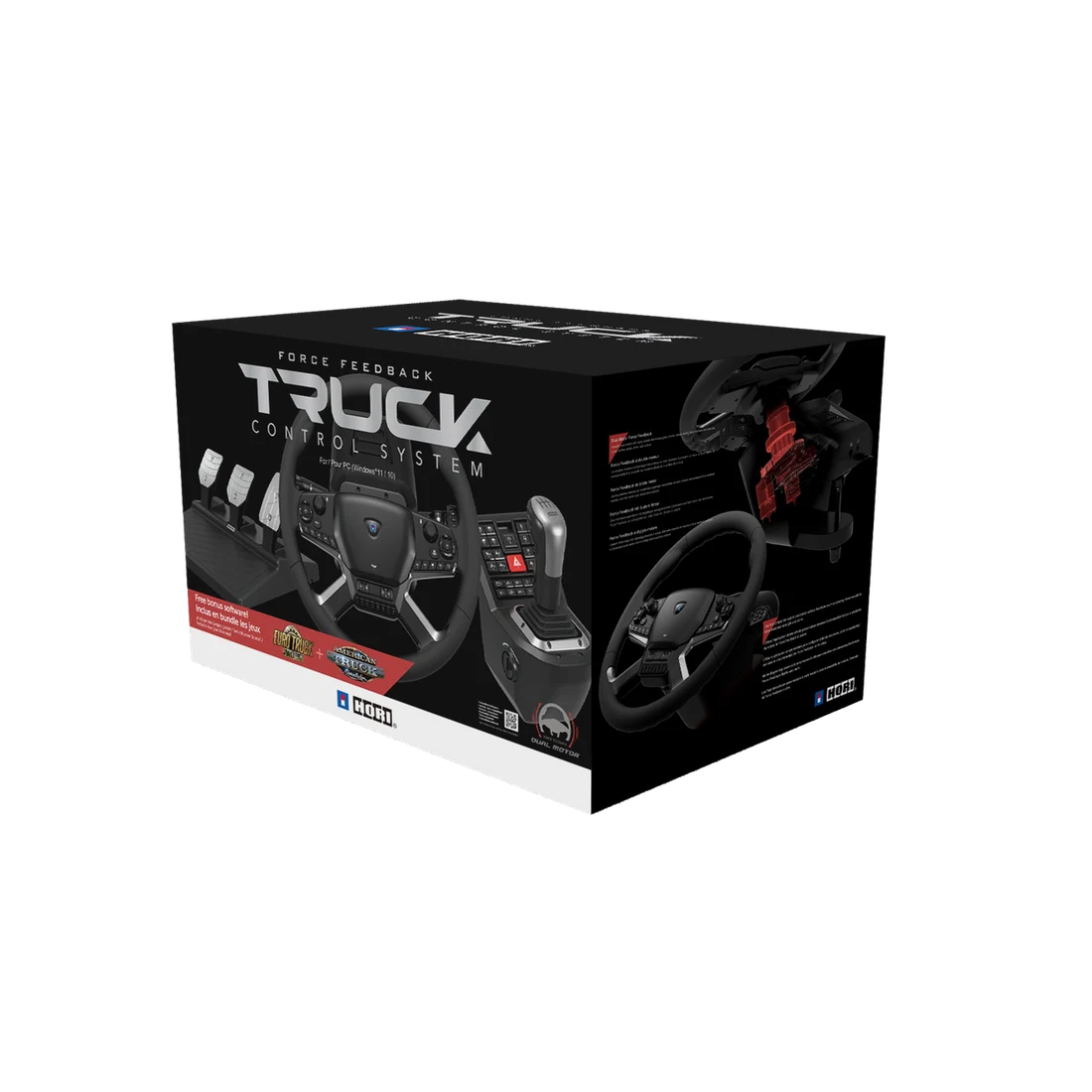
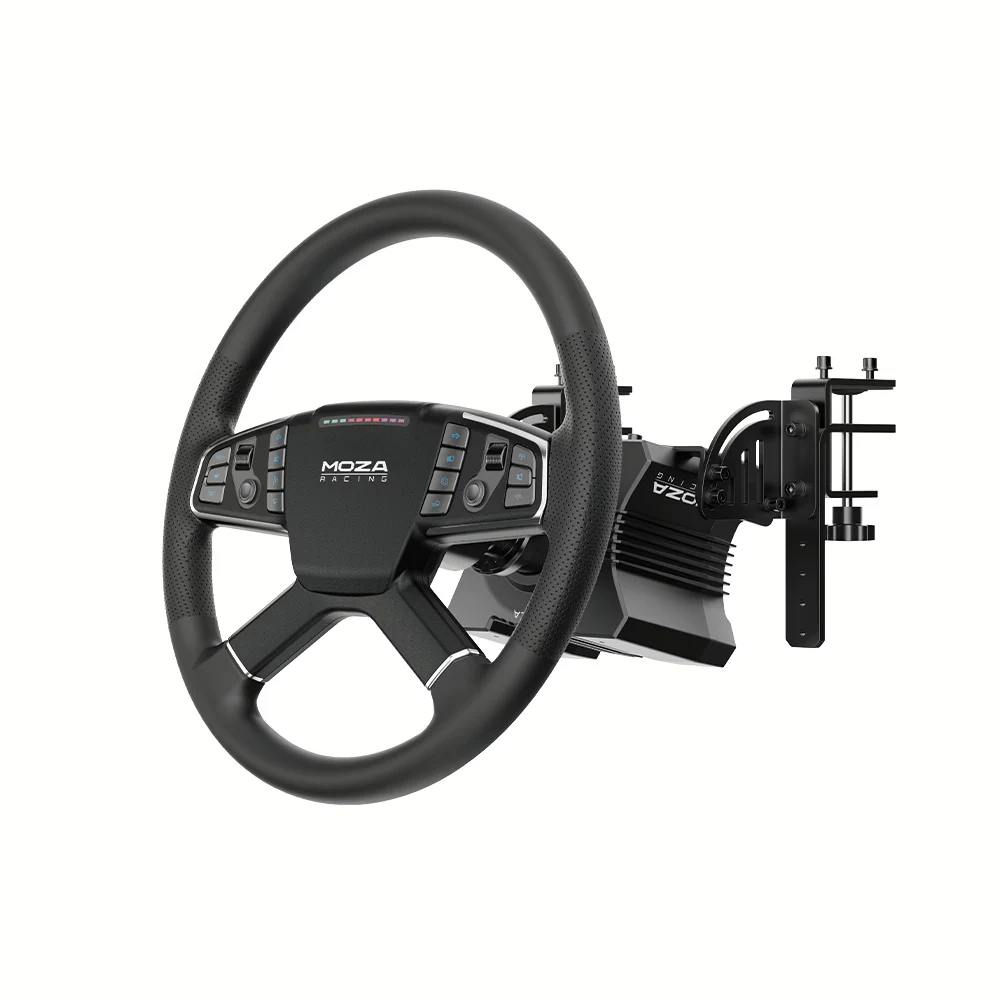
A $469-class MOZA bundle and a $600-class HORI system are not like-for-like if your finished MOZA build also needs a clutch pedal, HGP shifter, multi-function stalks, and a button deck. Compare the controls you will actually touch, not the first box that reaches checkout.
Steering feel: MOZA wins cleanly
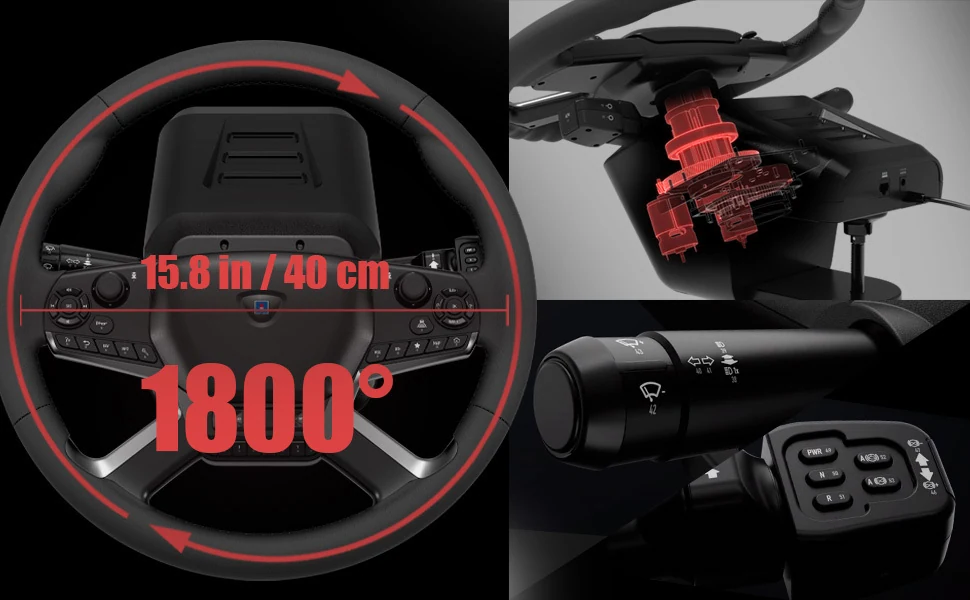
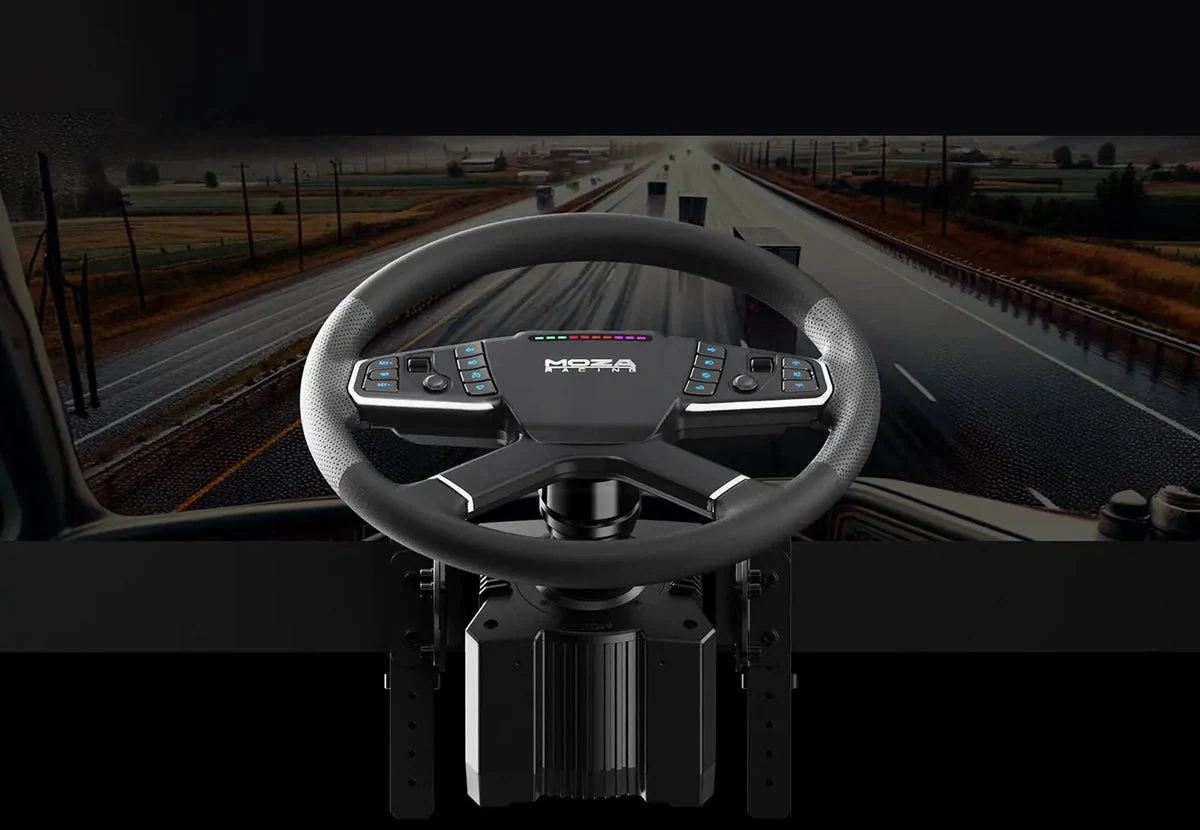
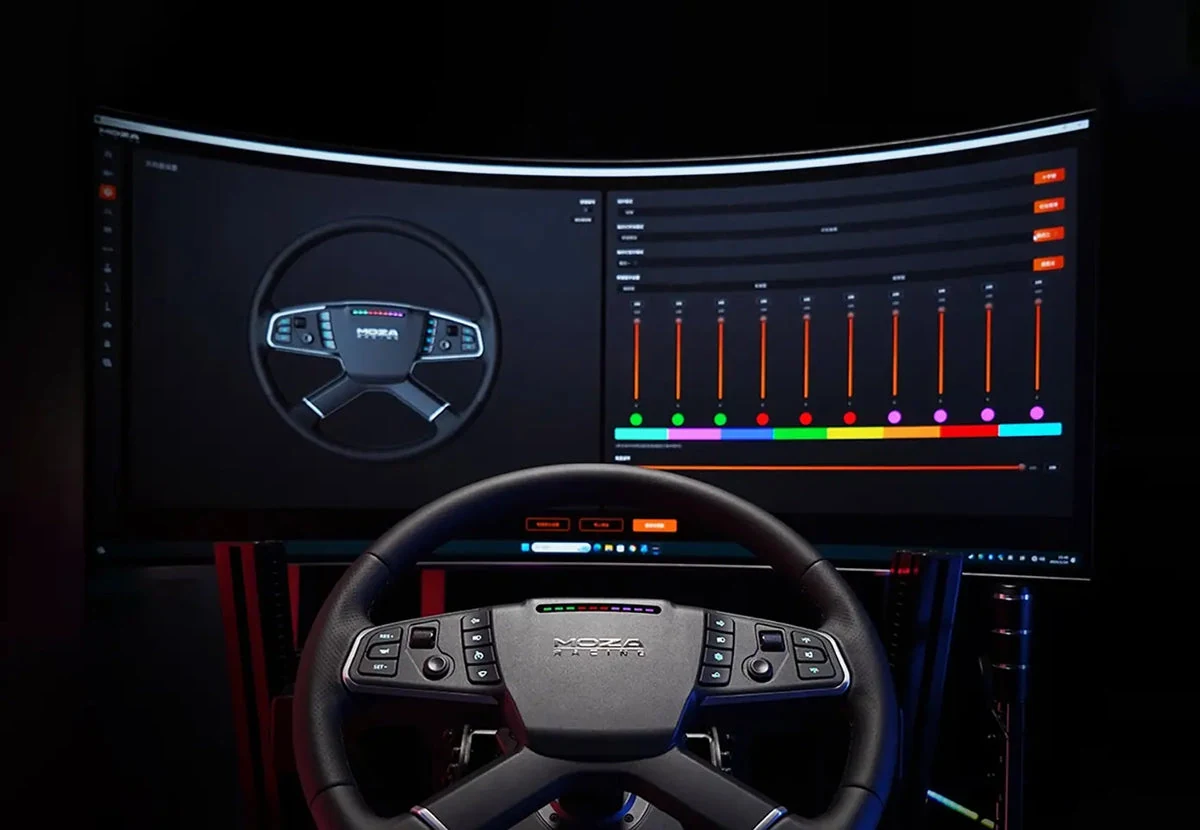
The R5 is a 5.5 Nm direct-drive base. There are no belts or gears between the motor and shaft, so small changes can arrive with less mechanical texture and less lash. MOZA lists a 15-bit encoder and 1000 Hz USB update rate, while Pit House supplies rotation, damping, friction, inertia, and game profiles. The TSW rim is large enough to feel like a truck control instead of a racing wheel wearing a costume.
HORI uses dual motors and helical gears. That is a meaningful step beyond a vibration-only toy, but owners and reviewers repeatedly describe a gear sensation, weaker center detail, or more mechanical texture than direct drive. It can still communicate road surface, steering weight, and self-centering. It simply does not erase its mechanism the way a well-tuned direct-drive base can.
If you also drive BeamNG, farming equipment, buses, rally cars, or normal circuit sims, the R5 base makes the stronger reusable foundation. If this is a one-game cockpit and the physical truck controls are what make you return every Friday night, force-feedback purity is not the only score.
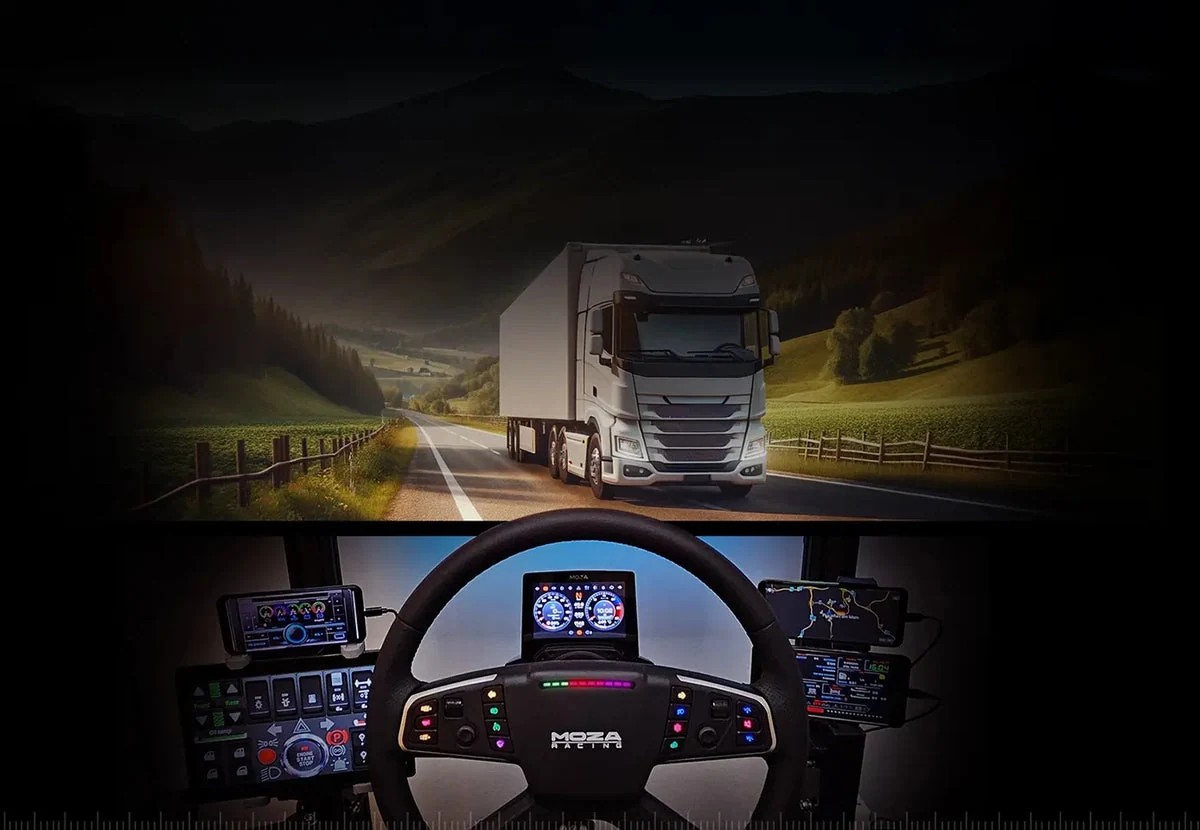
Control completeness: HORI wins by a mile
HORI’s advantage shows up when the route gets busy. Turn indicators and wipers live on stalks. Range and splitter changes live on the shifter. Navigation, lights, engine functions, cruise control, windows, camera movement, and dashboard actions have physical homes. HORI advertises 39 wheel inputs and a separate shifter/control panel with another large control bank. The exact marketing count varies by how axes and switches are counted, so the useful truth is simpler: there are far more truck-specific physical controls in the box.
MOZA’s TSW is not bare. It has 14 short-travel buttons, two thumbwheels, two joysticks, and RGB indicators. That is enough for a strong base layer, and Pit House makes it flexible. It is not the same as having a physical range/splitter shifter and steering-column stalks. The optional MOZA multi-function stalks solve a large part of that gap, and the HGP shifter adds a solid metal seven-speed-plus-reverse mechanism, but each part adds cost, mounting, wiring, and mapping.
One experienced owner who had used both systems summarized the trade in a way the spec sheets miss: MOZA delivered the better force feedback, but HORI made ETS2 feel easier and more enjoyable because the controls were where a truck driver expected them. That is not a universal verdict. It is the right question.
Desk fit: the dimension nobody photographs
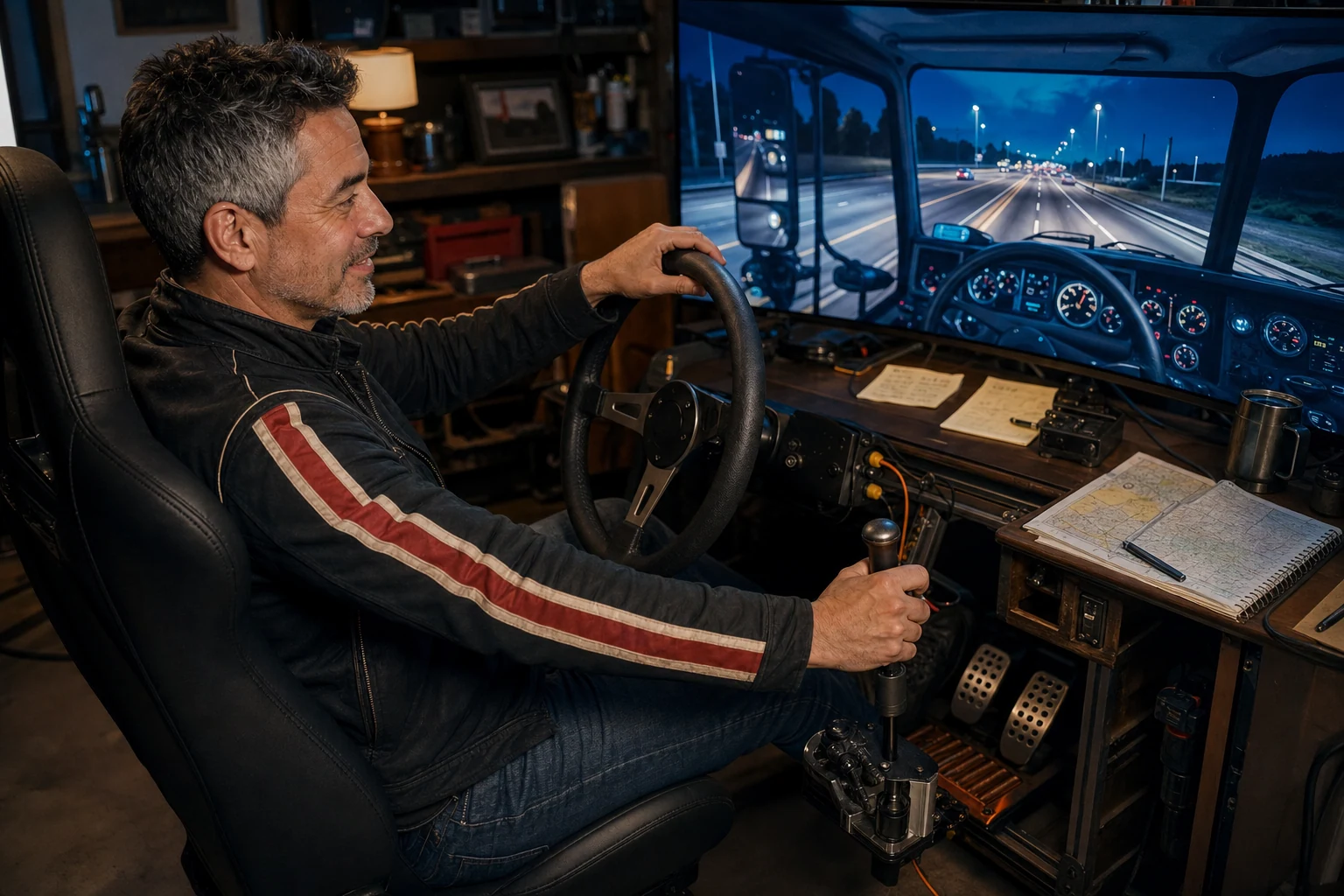
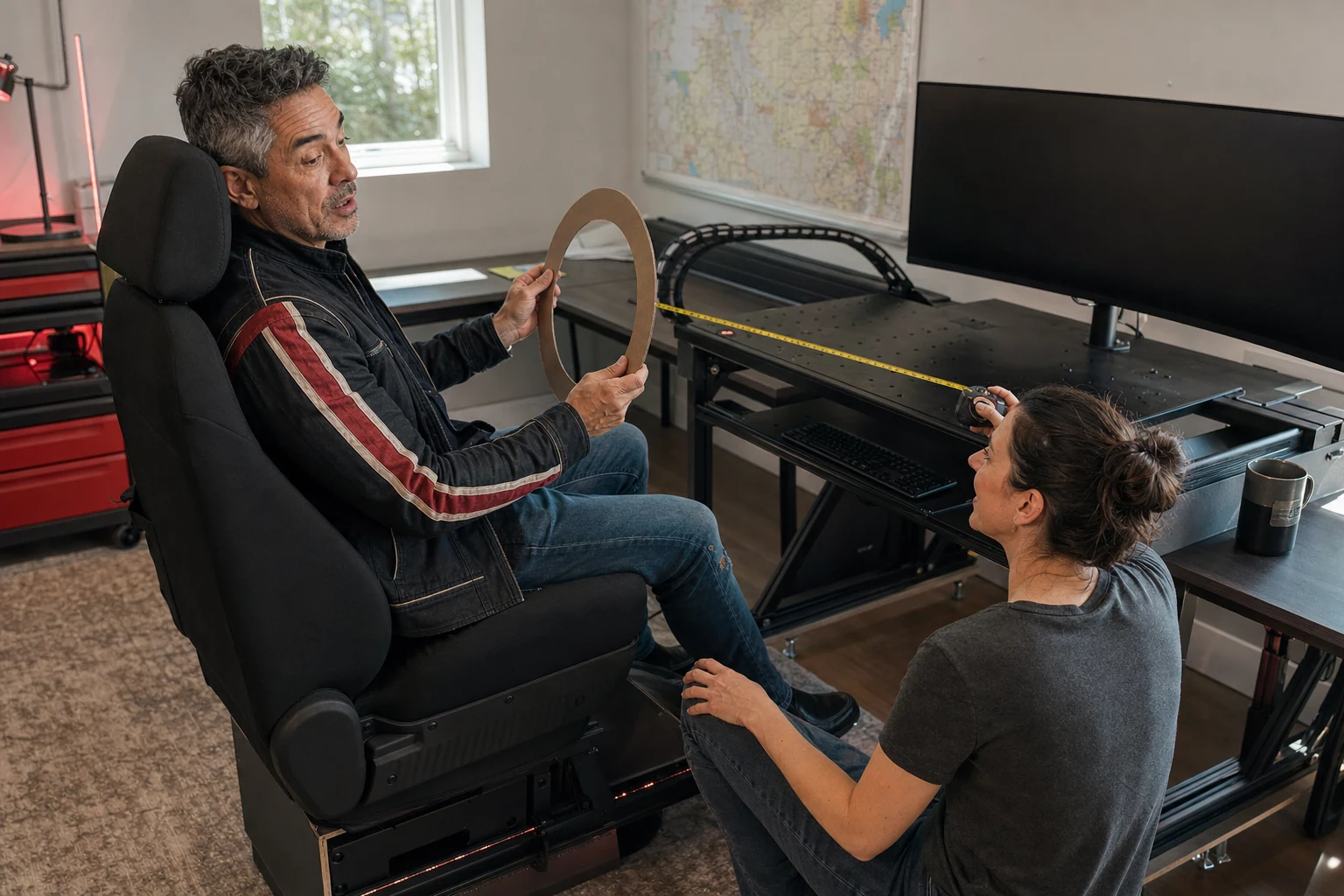
A 400 mm wheel changes seating geometry. The rim itself is wider, the hub is deeper, and truck clamps angle the base upward. Several owners report that the assembly pushes them substantially farther from the monitor than a compact racing wheel did. The screen that felt generous at racing-wheel distance can feel small from the new seating point.
Before ordering, measure five things:
- Desk thickness and underside crossbars. A clamp can clear the tabletop and still collide with a steel support rail.
- Clamp depth. Measure from the front edge to the first obstruction, not just tabletop thickness.
- Driver-to-monitor distance after mounting. Mock a 400 mm circle from cardboard and sit behind it.
- Shifter reach. Your shoulder should remain against the seat when selecting the farthest gate or button.
- Chair movement under braking. Three pedals are not useful if the office chair rolls backward every time the truck slows.
MOZA specifies a 3-70 mm desk-thickness range and up to 75 degrees of angle adjustment for its truck clamp. HORI supplies wheel and shifter clamps and also provides mounting points. Neither promise can see the crossbar under your desk.

HORI setup: update first, map second
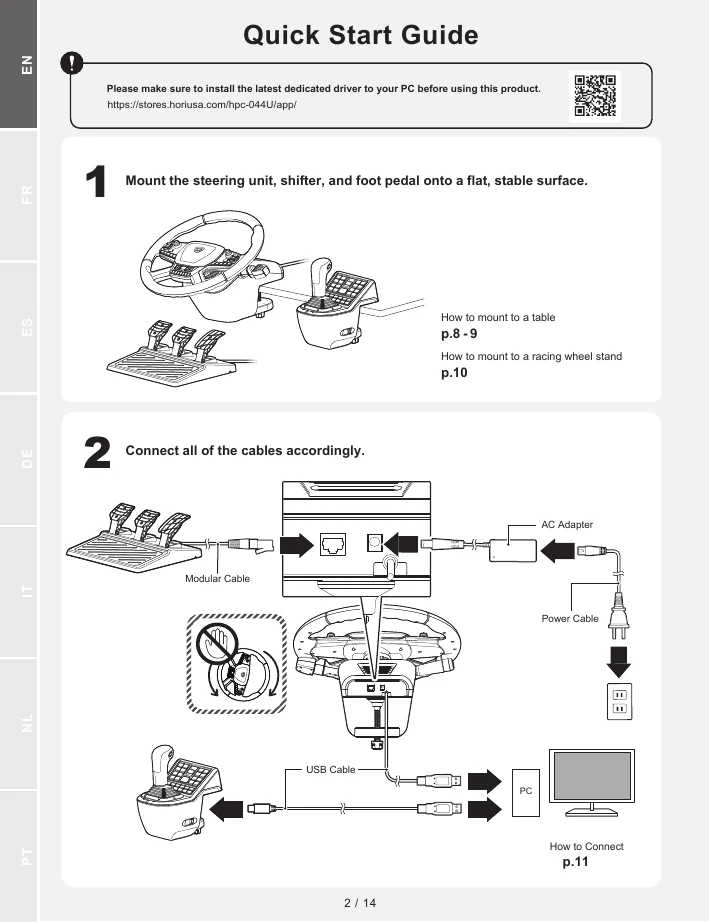
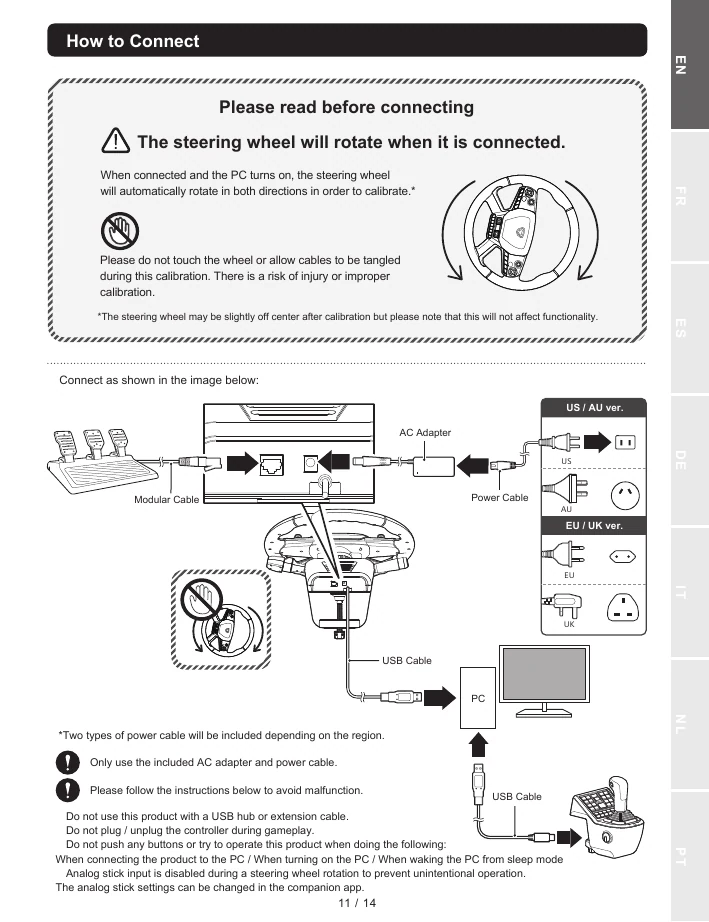
HORI puts an unusually blunt warning on the current product page: install Driver 1.18 and update the shifter firmware. Take that seriously. The official manual shows the pedal cable connecting to the wheel, wheel power connecting separately, and wheel and shifter each taking their own USB path to the PC.
A clean first-night order is:
- Build and clamp the wheel, shifter, and pedals with the PC off.
- Connect pedals to the wheel, then wheel power.
- Install HORI Device Manager and the current driver from HORI’s support page.
- Connect wheel and shifter directly to the PC for the initial firmware pass.
- Update the shifter firmware before opening ATS or ETS2.
- Confirm wheel center, pedal travel, shifter inputs, and both analog sticks in the manager.
- Launch a supported profile, test a short route, and only then change bindings.
This avoids the classic failure mode: remapping an outdated device, creating conflicts, and then not knowing whether a missed input came from firmware, the game profile, or your own binding layer.
MOZA setup: treat the bundle as an ecosystem
The MOZA build is simpler at the wheelbase and more expandable around it. Mount the truck clamp securely, attach the R5, install the TSW rim, connect SR-P Lite pedals, power, and USB, then configure Pit House before opening the game. Confirm center and rotation, keep overall force conservative, and test one change at a time.
The optional parts need an intentional plan. Add the clutch only if you intend to drive manual transmissions. Add the HGP shifter if physical gate selection and range/splitter workflow matter enough to justify another mount. Add the multi-function stalks if indicators, lights, and wipers are the immersion gap you notice every route. A Stream Deck or button box may be the more flexible answer if you rotate among truck, bus, farming, and racing sims.
MOZA’s current support material and product pages were checked, but an older direct TSW manual link indexed by search no longer resolved during this review. That is not a product failure; it is a documentation-path annoyance. Use the current MOZA support portal and product page rather than an old PDF bookmark.
What owners love, and what makes them return it
HORI: reasons to buy
- It feels designed around ATS and ETS2 rather than adapted from racing.
- The wheel diameter, stalks, analog sticks, shifter, range/splitter controls, and three pedals create a coherent routine quickly.
- Supported-game mapping reduces the first-night binding tax.
- Owners who value the complete truck workflow often forgive the less sophisticated force feedback.
HORI: reasons to hesitate
- The mechanism and material feel do not match what many buyers expect at full list price.
- Plastic clamps and a large assembly can flex or sit awkwardly on the wrong desk.
- Buttons behind or around the shifter can be difficult to see or reach while driving.
- Separate wheel and shifter USB connections add cable management.
- The product is PC-first and specialized. It is a poor buy if normal racing is equally important.
MOZA: reasons to buy
- Direct drive produces the cleaner steering foundation.
- The R5 can serve truck, road, rally, bus, farming, and casual racing builds.
- The TSW wheel, truck clamp, Pit House tuning, and broader ecosystem create a credible upgrade path.
- Metal construction and modular pieces feel more like long-term hardware than a single appliance.
MOZA: reasons to hesitate
- The standard trucking bundle is visibly incomplete for a manual-truck fantasy: two pedals, no shifter, no stalks.
- The full build adds mounts, USB paths, software, and a meaningfully larger total.
- Reviewers have criticized the TSW’s small face buttons and the weight/space of a completed setup.
- Community reports around the HGP shifter include noise, cable, and calibration complaints. They are not universal, but they are worth reading before adding it automatically.
The community disagreement is useful. It means there is no fake universal winner. People optimizing the steering signal choose MOZA. People optimizing the dedicated trucking ritual can choose HORI and remain perfectly rational.
The third option: use the wheel you already own
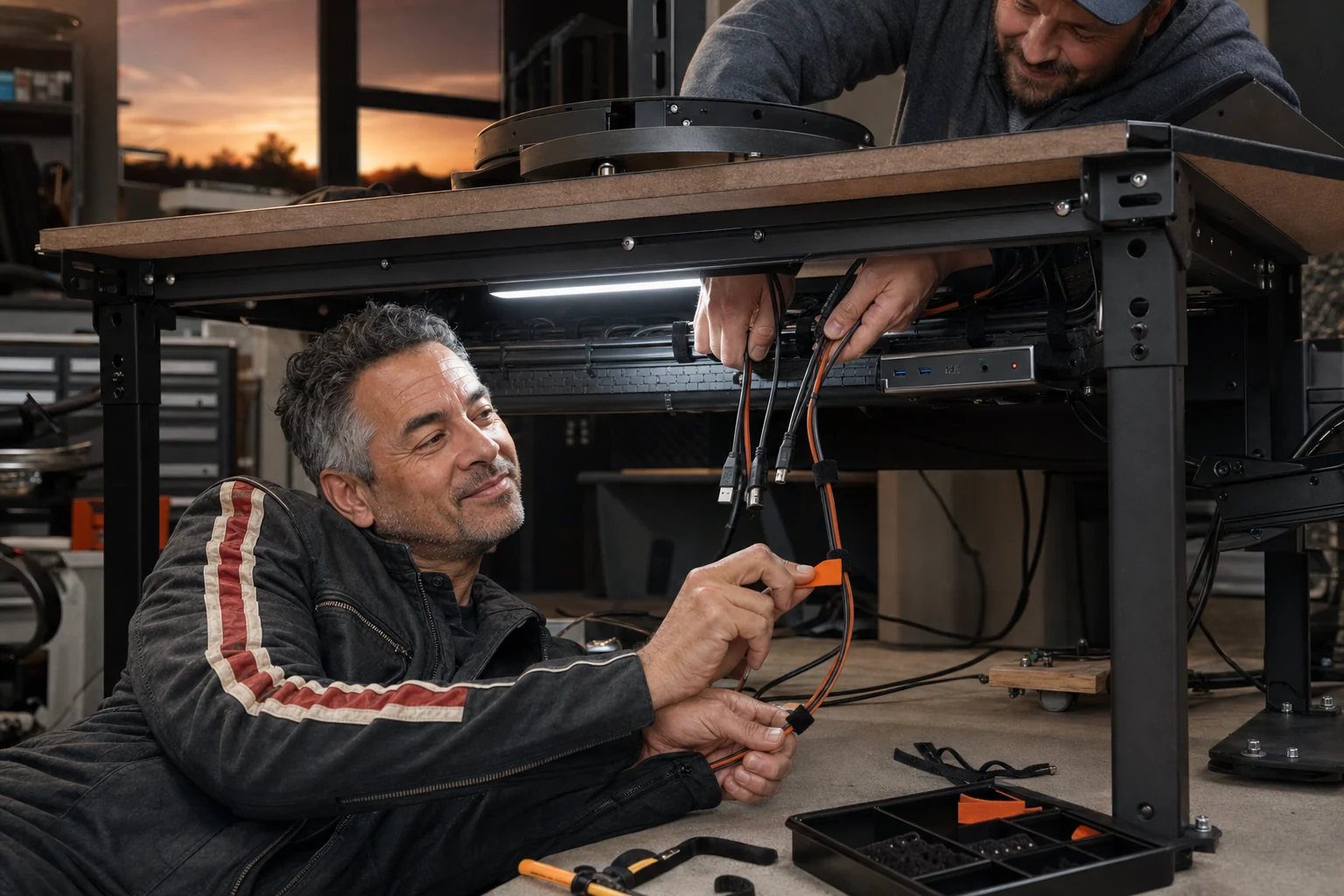
The internet turns every interest into a hardware identity too quickly. ATS and ETS2 work with common Logitech and Thrustmaster wheels. A G29, G920, G923, or T300 gives you steering, pedals, and enough buttons to learn whether long routes actually become part of your week.
You give up the large rim, 1800-degree feel, stalks, integrated truck shifter, and a lot of physical control density. You gain a zero- or low-cost test. Put a few dozen hours into the game, learn whether you prefer automatic, sequential, or manual shifting, and notice which keyboard actions annoy you. That list tells you whether you need HORI’s appliance or MOZA’s ecosystem.
For many new players, head tracking, a stable chair, and moving the monitor closer produce more immersion per dollar than replacing a wheel that already works. The dedicated truck wheel becomes obvious after the habit exists.
Buy paths by personality
Buy HORI now if you play ATS or ETS2 almost exclusively, want a manual-style control routine on night one, dislike assembling ecosystems, and can accept that the force feedback is functional rather than premium. A substantial sale makes this answer easier.
Buy MOZA now if you care about steering fidelity, also play racing or driving sims, enjoy tuning, and intend to add controls over time. Price the finished rig, not the base bundle.
Wait and keep Logitech if you are new, short on desk space, using a rolling chair, or unsure whether you will drive weekly. Your first purchase should solve the first frustration you can name.
Skip both if you need console support, cannot permanently clear the desk depth, or expect a quiet folding setup that disappears after every session. These are large PC-first controls.
What to buy
Duke’s bottom line
MOZA is the winner if the question is which company makes the better steering system? HORI is the winner if the question is which single box turns ATS and ETS2 into a recognizable truck-driving routine fastest?
At full price, HORI needs you to value completeness more than material and motor quality. MOZA needs you to admit the bundle is only the first invoice. The smartest buyer names the missing experience first: steering fidelity, mapped controls, manual shifting, stalks, or simply more time in the game.
The MOZA is the better wheel. The HORI may be the better Friday night. Decide whether your hands are buying a steering signal or a whole routine.
Sources and research shelf
Source review date: July 15, 2026. Prices, stock, retailer bundles, firmware, and software support can change. Exact Amazon ASINs above were checked as direct product paths; verify the seller and included components at checkout.
- HORI Truck Control System official product page — specifications, package contents, driver warning, included game codes, and mounting.
- HORI official manual shelf — current instruction manual and device-manager support path.
- HORI official compatibility page — supported game list and current notes.
- MOZA R5 Trucking Bundle official product page — current bundle contents, R5 specifications, pedals, and truck clamp.
- MOZA TSW Truck Wheel official product page — wheel size, controls, materials, and ecosystem detail.
- MOZA hardware compatibility guide — base, accessory, and platform compatibility.
- MOZA Ultimate Truck Sim Guide — current manufacturer setup and upgrade framing.
- Windows Central MOZA TSW review — direct-drive feel, button criticism, weight, and setup observations.
- GameStar HORI Truck Control System test — desk fit, connections, shifter workflow, and control visibility.
- Fellowsfilm HORI Truck Control System review — owner-oriented desk-depth, wheel-angle, and value caveats.
- r/trucksim June 2026 HORI buying discussion — current demand, sale context, and owner trade-offs.
- r/trucksim HORI versus MOZA discussion — complete controls versus force-feedback quality.
- r/EuroTruck2 HORI owner discussion — setup, feel, and dedicated-game perspective.
- r/trucksim long-term HORI versus MOZA owner take — first-hand workflow comparison and reasons an owner preferred the complete HORI routine.
- SCS Software forum HORI Truck Control System thread — firmware, mapping, desk fit, and ownership troubleshooting.
- SCS Software forum truck-controller discussion — current alternative-control and setup context.
- American Truck Simulator Steam hardware discussion — buyer questions and practical community answers.
Key takeaways & quick answers
IgnitionSim is reader-supported. When you buy through links on our site we may earn an affiliate commission at no extra cost to you — it never changes our verdict or your price. As an Amazon Associate we earn from qualifying purchases.
Keep reading
Wheel Stand vs Fixed Cockpit vs 8020 Rig: The 2026 Rigidity Guide for Direct Drive and Load Cells
A stronger wheelbase does not fix a weak frame. This is the cockpit decision that decides whether your pedals, torque, and future motion upgrades behave.
Direct Drive in 2026: Do You Actually Need It (and How Much Torque Is Enough)?
Yes, you probably want direct drive in 2026 — because it now costs what a belt wheel does. Here's the honest DD-vs-belt case, why 5Nm is enough to start, and where more torque stops buying lap time.
Sim Racing Rig Buyer Map 2026: What to Buy First, What to Skip, and Where the Money Actually Matters
Start here if you want a real sim rig without buying the same cockpit twice. Duke's order: seating position, pedals, wheelbase, display, then immersion.
Best Farming Simulator 25 Controls in 2026: Thrustmaster T128 SimTask vs HORI vs Logitech
The best new FS25 bundle is not automatically the best upgrade. Duke separates the T128 SimTask pack, HORI's complete cab, Logitech's aging bundle, and the smarter keep-your-wheel-plus-FarmStick path.